Telemedicine
- Manyanshi Joshi
- 4 days ago
- 7 min read

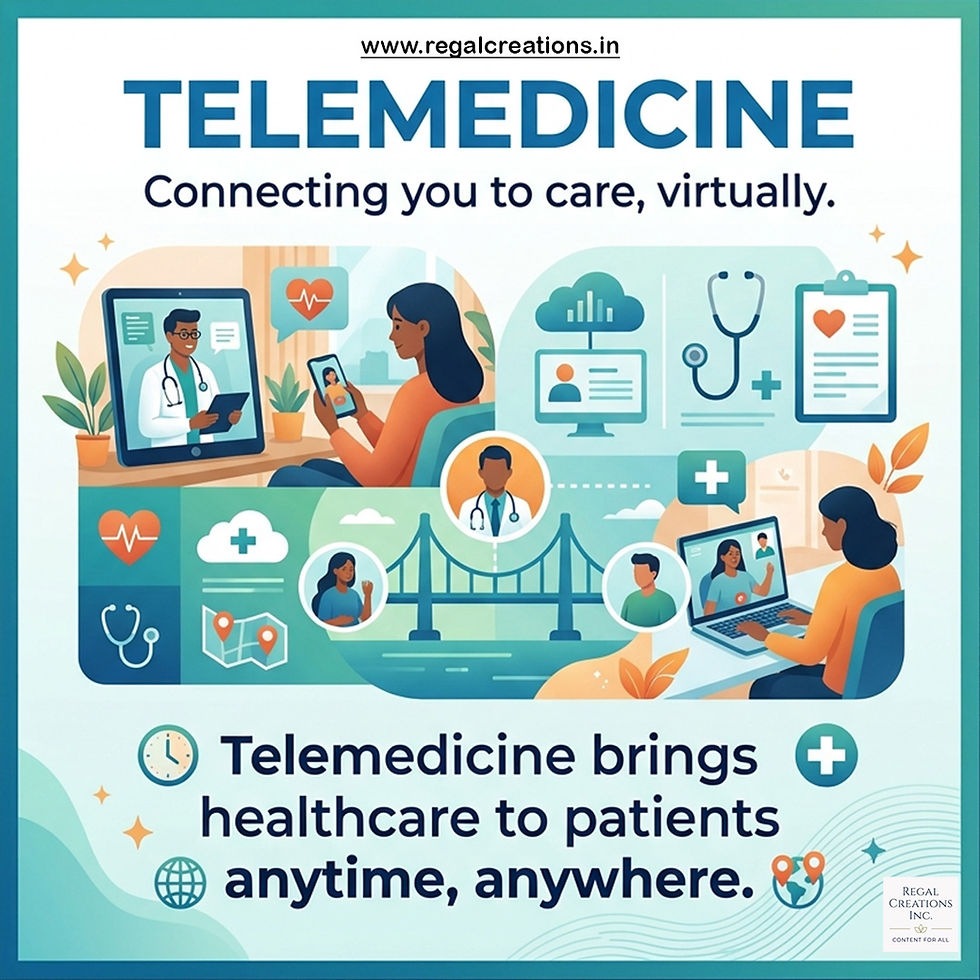
Telemedicine is the delivery of healthcare services remotely using technology such as video calls, phone calls, messaging, or mobile apps. It allows patients to consult healthcare providers without visiting a clinic or hospital in person.
Common Uses of Telemedicine
Routine doctor consultations
Follow-up visits
Mental health counseling
Prescription renewals
Chronic disease management (e.g., diabetes, hypertension)
Minor illness evaluation (cold, flu, rashes)
Remote monitoring using wearable devices
Benefits
Convenient and time-saving
Improves access for rural or mobility-limited patients
Reduces travel and waiting times
Can lower healthcare costs
Helps reduce exposure to contagious diseases
Limitations
Limited physical examination capability
Requires internet and device access
Not ideal for emergencies
Privacy and cybersecurity concerns
Some conditions still require in-person testing or procedures
Types of Telemedicine
Synchronous — live video or phone consultation
Asynchronous — sending messages, photos, or reports for later review
Remote Patient Monitoring — devices transmit health data to providers
Technologies Used
Video conferencing platforms
Mobile health apps
Electronic health records (EHR)
Wearable health trackers
Secure messaging systems
Examples of Telemedicine Providers
Advantages and Disadvantages of Telemedicine
Advantages of Telemedicine
1. Convenience
Patients can consult doctors from home using smartphones or computers, saving travel time and effort.
2. Better Access to Healthcare
People living in rural or remote areas can connect with specialists who may not be available nearby.
3. Time-Saving
Telemedicine reduces long waiting times in hospitals and clinics.
4. Cost-Effective
Patients spend less on transportation, accommodation, and hospital visits.
5. Reduced Risk of Infection
Remote consultations help limit exposure to contagious diseases in crowded healthcare settings.
6. Continuous Monitoring
Doctors can monitor patients with chronic diseases through wearable devices and online reports.
7. Mental Health Support
Online counseling and therapy sessions make mental healthcare more accessible and comfortable.
Disadvantages of Telemedicine
1. Limited Physical Examination
Doctors cannot perform detailed physical checks or medical procedures remotely.
2. Technology Dependence
Good internet connection and digital devices are necessary, which may not be available to everyone.
3. Privacy and Security Risks
Patient data may be vulnerable to hacking or unauthorized access if systems are not secure.
4. Less Personal Interaction
Some patients may feel less connected to doctors during virtual consultations.
5. Not Suitable for Emergencies
Serious injuries, surgeries, and emergency conditions require immediate in-person treatment.
6. Technical Problems
Video or audio issues can interrupt communication and affect diagnosis quality.
7. Digital Literacy Issues
Elderly or less tech-savvy patients may struggle to use telemedicine platforms.
Telemedicine is transforming modern healthcare by making medical services more accessible, convenient, and efficient. However, it cannot completely replace traditional healthcare because some treatments and examinations still require face-to-face medical care.
Telemedicine in Healthcare Management
Telemedicine plays an important role in modern healthcare management by improving communication, patient care, and hospital efficiency through digital technology.
Role of Telemedicine in Healthcare Management
1. Remote Patient Care
Doctors and healthcare providers can monitor and treat patients from distant locations using video calls, mobile apps, and online platforms.
2. Improved Hospital Efficiency
Telemedicine reduces overcrowding in hospitals and clinics by handling routine consultations online.
3. Better Access to Specialists
Patients in rural or underserved areas can connect with experienced specialists without traveling long distances.
4. Chronic Disease Management
Patients with diabetes, hypertension, asthma, and heart diseases can receive continuous monitoring and regular follow-ups remotely.
5. Emergency Support
Healthcare professionals can provide quick medical advice during emergencies before patients reach hospitals.
6. Cost Management
Telemedicine lowers operational costs for healthcare institutions and reduces travel expenses for patients.
7. Digital Health Records
Healthcare management systems can store patient information electronically, making diagnosis and treatment more organized and efficient.
8. Mental Health Services
Online counseling and psychiatric consultations help improve mental healthcare accessibility.
Technologies Used in Telemedicine
Video conferencing
Mobile health apps
Electronic Health Records (EHR)
Wearable health devices
AI-based health monitoring systems
Challenges in Healthcare Management
Data privacy and cybersecurity risks
Internet connectivity issues
Lack of digital literacy
Limited physical examination capability
Regulatory and legal concerns
Future of Telemedicine
Telemedicine is expected to grow rapidly with advancements in artificial intelligence, 5G networks, wearable devices, and remote diagnostics. It will become an important part of smart healthcare systems worldwide.
Recent Trends and Innovations in Telemedicine
Telemedicine is rapidly evolving with new technologies that improve healthcare access, diagnosis, and patient care.
1. Artificial Intelligence (AI) in Healthcare
AI-powered systems help doctors analyze symptoms, detect diseases, and provide faster diagnoses. Chatbots and virtual health assistants are also becoming common.
Example
AI tools can identify early signs of diseases like cancer or heart problems from medical scans.
2. Wearable Health Devices
Smartwatches and fitness bands can monitor heart rate, oxygen levels, sleep, blood pressure, and physical activity in real time.
Examples
Apple Watch
Fitbit devices
These devices send health data directly to doctors for remote monitoring.
3. Remote Patient Monitoring (RPM)
Hospitals now use connected medical devices to monitor patients with chronic diseases from home.
Benefits
Reduces hospital visits
Improves long-term disease management
Provides faster emergency alerts
4. 5G Technology
Faster internet through 5G improves video consultations with better quality and lower delays.
Impact
Smooth real-time communication
Faster transfer of medical data
Better support for remote surgeries
5. Virtual Mental Health Services
Online therapy and counseling platforms are growing rapidly, especially after the COVID-19 pandemic.
Examples
Stress management apps
Video therapy sessions
AI mental health chat support
6. Electronic Health Records (EHR)
Digital medical records allow doctors to access patient history quickly and improve treatment coordination.
Advantages
Faster diagnosis
Better record management
Reduced paperwork
7. Telemedicine Mobile Apps
Healthcare apps now allow patients to:
Book appointments
Receive prescriptions
Consult doctors online
Access medical reports instantly
Examples
8. Robotics and Remote Surgery
Advanced robotic systems help surgeons perform operations remotely with high precision.
Example
Robotic-assisted surgery systems are being used in advanced hospitals worldwide.
9. Cloud-Based Healthcare Systems
Cloud technology stores medical data securely and allows hospitals to share information efficiently.
Benefits
Easy access to records
Improved collaboration
Better data backup and recovery
10. Personalized Digital Healthcare
Telemedicine platforms now use patient data to provide customized treatment plans and health recommendations.
The Shift Toward Digital Healthcare
The shift toward digital healthcare refers to the growing use of technology and internet-based services to improve medical care, communication, and health management. Hospitals, clinics, and patients are increasingly using digital tools for faster, smarter, and more accessible healthcare services.
Reasons for the Shift
1. Technological Advancements
The rise of smartphones, high-speed internet, artificial intelligence, and cloud computing has made digital healthcare more efficient and widely available.
2. Increased Demand for Convenience
Patients prefer online appointments, digital prescriptions, and remote consultations because they save time and effort.
3. COVID-19 Pandemic Impact
The pandemic accelerated the adoption of telemedicine and online healthcare services worldwide.
4. Growing Health Awareness
People are using health apps and wearable devices to monitor fitness, sleep, heart rate, and overall wellness.
Key Features of Digital Healthcare
Telemedicine
Patients can consult doctors remotely through video calls and mobile apps.
Electronic Health Records (EHR)
Digital records help hospitals manage patient information quickly and accurately.
Wearable Devices
Smartwatches and fitness trackers monitor health in real time.
Artificial Intelligence (AI)
AI assists doctors in diagnosis, treatment planning, and disease prediction.
Mobile Health Apps
Apps provide appointment booking, medicine reminders, and health tracking.
Benefits of Digital Healthcare
Faster medical services
Better access for rural populations
Reduced healthcare costs
Improved patient monitoring
Efficient hospital management
Early disease detection through AI and data analysis
Challenges
Data privacy and cybersecurity risks
Dependence on internet connectivity
Digital literacy issues
High technology costs
Limited physical examination capability
Future of Digital Healthcare
Digital healthcare is expected to grow with:
AI-powered diagnostics
5G-enabled telemedicine
Smart hospitals
Remote robotic surgeries
Personalized medicine using big data
Countries worldwide are investing heavily in digital health systems to improve healthcare quality and accessibility.
AI Diagnostics
AI diagnostics refers to the use of Artificial Intelligence (AI) to detect, analyze, and predict diseases using medical data such as scans, reports, symptoms, and patient history.
AI systems can process large amounts of healthcare information quickly and help doctors make faster and more accurate decisions.
How AI Diagnostics Works
AI uses technologies like:
Machine Learning (ML)
Deep Learning
Neural Networks
Data Analytics
These systems study medical patterns from thousands of cases and learn to identify signs of diseases.
Applications of AI Diagnostics
1. Medical Imaging
AI can analyze:
X-rays
CT scans
MRI scans
Ultrasounds
to detect diseases like cancer, pneumonia, and fractures.
2. Disease Prediction
AI helps predict conditions such as:
Heart disease
Diabetes
Stroke risk
Alzheimer’s disease
3. Pathology and Lab Testing
AI can examine blood samples and tissue images more efficiently.
4. Virtual Health Assistants
AI chatbots and symptom checkers guide patients before they visit doctors.
5. Personalized Treatment
AI analyzes patient data to suggest customized treatment plans.
Advantages of AI Diagnostics
Faster diagnosis
Improved accuracy
Early disease detection
Reduced workload for doctors
Better healthcare access in remote areas
Continuous patient monitoring
Challenges and Concerns
Data privacy risks
Dependence on quality data
High implementation costs
Ethical concerns in decision-making
Possibility of incorrect predictions
Limited human empathy and judgment
Real-World Examples
IBM Watson Health used AI for medical data analysis.
Google Health develops AI tools for disease detection.
AI systems are being used to detect diabetic eye disease and certain cancers with high accuracy.
Future of AI Diagnostics
AI diagnostics is expected to become more advanced with:
Real-time monitoring
AI-powered wearable devices
Faster drug discovery
Robotic-assisted healthcare
More accurate predictive medicine
AI will likely work alongside doctors rather than replace them completely.
Conclusion on Telemedicine
Telemedicine has transformed modern healthcare by making medical services more accessible, convenient, and efficient through digital technology. It helps patients connect with healthcare professionals remotely, reduces travel and waiting time, and improves healthcare access for people in rural and remote areas. Although challenges such as internet dependence, privacy concerns, and limited physical examinations still exist, telemedicine continues to grow with advancements in AI, 5G, and digital health systems. It is becoming an essential part of the future of healthcare worldwide.
Thanks for reading!!!!



Comments