The future of money
- Manyanshi Joshi
- May 5
- 6 min read

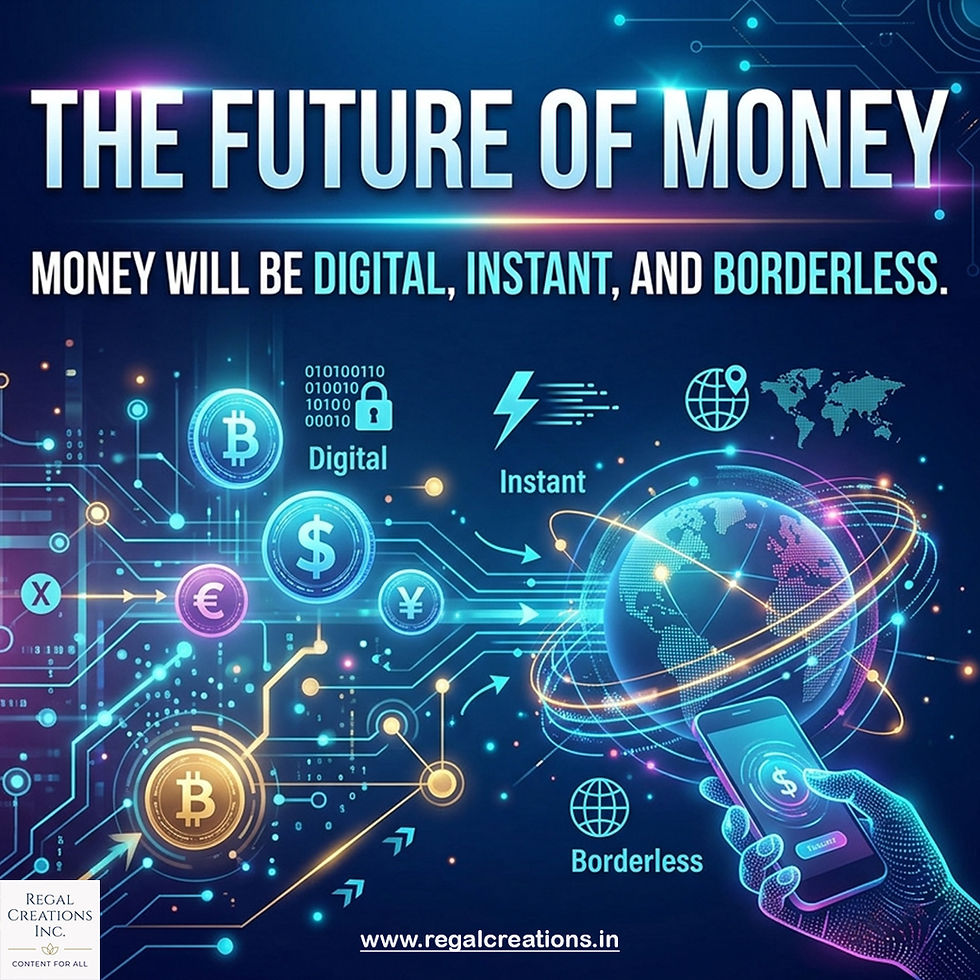
The “future of money” isn’t one single thing replacing everything else—it’s a mix of technologies, policies, and behaviors reshaping how value moves. Here’s a clear way to think about where things are heading:
💳 1. Money is becoming fully digital
Physical cash is steadily declining in many parts of the world. Payments are shifting toward:
Mobile wallets (Apple Pay, Google Pay, etc.)
Instant bank transfers
Contactless payments
In some countries, cash is already a small fraction of transactions. The long-term direction is frictionless, invisible payments—you won’t even think about “paying,” it’ll just happen.
🪙 2. Cryptocurrencies & decentralized finance (DeFi)
Crypto introduced the idea that money doesn’t need a central authority.
Bitcoin → digital store of value (like “digital gold”)
Ethereum & others → programmable money (smart contracts)
DeFi → lending, trading, and earning interest without banks
That said, crypto is still volatile and evolving. It’s unlikely to fully replace traditional money, but it’s influencing how financial systems are built.
🏦 3. Central Bank Digital Currencies (CBDCs)
Governments are responding to crypto by creating their own digital money.
Digital versions of national currencies (like a digital dollar, euro, or yuan)
Controlled by central banks
Faster payments, more traceability
This could reshape banking, but raises concerns about privacy and surveillance.
🌐 4. Borderless and instant payments
Sending money internationally is currently slow and expensive. That’s changing through:
Blockchain-based transfers
Fintech platforms (e.g., Wise, Revolut)
Real-time payment networks
The future: sending money globally as easily as sending a text message.
🤖 5. AI + money
AI is starting to manage and move money:
Automated investing (robo-advisors)
Smart budgeting tools
Fraud detection in real time
In the future, AI could act almost like a personal financial assistant, making decisions on your behalf.
🔐 6. Identity and security will matter more
As money becomes digital:
Biometric authentication (face, fingerprint)
Digital identity systems
Stronger encryption
The trade-off: more convenience vs. less anonymity.
⚖️ 7. Big tensions shaping the future
Several forces will determine what “wins”:
Privacy vs. control (crypto vs. CBDCs)
Centralization vs. decentralization
Innovation vs. regulation
🧠 Bottom line
The future of money will likely be:
Mostly digital
Increasingly instant and global
A mix of government-backed and decentralized systems
More automated and embedded in everyday life
Preparing for the future of money isn’t about chasing every new trend—it’s about becoming adaptable, digitally fluent, and financially resilient. Here’s a grounded way to get ready without overcomplicating things:
🧠 1. Build strong financial fundamentals first
Before touching crypto or new tech, get the basics right:
Emergency fund (3–6 months of expenses)
Low or manageable debt
Consistent investing habit
If your foundation is weak, new financial tools won’t fix it—they’ll amplify mistakes.
💻 2. Get comfortable with digital finance
You don’t need to be a tech expert, but you should be fluent in modern money tools:
Use mobile banking and UPI apps
Track spending with apps or spreadsheets
Understand how digital payments, wallets, and transfers work
In India, systems like UPI are already a glimpse of the future.
🪙 3. Learn crypto—but don’t blindly invest
Understand the basics of:
Bitcoin and Ethereum
Blockchain and wallets
Risks (volatility, scams, regulation)
If you invest:
Keep it small (a speculative portion, not your core savings)
Avoid “get rich quick” thinking—it’s where most people lose money
🏦 4. Expect changes from governments and banks
Digital currencies from central banks (CBDCs) may become normal. That means:
More transparency in transactions
Faster payments
Possibly less privacy
Stay informed so you’re not caught off guard by policy changes.
🌍 5. Think globally
Money is becoming borderless. You can:
Work remotely for global companies
Invest internationally
Use platforms like Wise or Revolut for cross-border transactions
Your earning and investing opportunities won’t be limited to your country.
🤖 6. Use automation to your advantage
Let systems do the heavy lifting:
Auto-invest in mutual funds or ETFs
Set savings rules
Use budgeting tools
The future favors people who design systems, not just rely on discipline.
🔐 7. Take security seriously
As money goes digital, you become your own first line of defense:
Use strong, unique passwords (password manager helps)
Enable 2-factor authentication
Never share OTPs or private keys
One mistake here can wipe out everything.
📚 8. Keep learning (this matters more than any single asset)
The biggest edge isn’t picking the “right” currency—it’s adapting faster than others:
Follow financial and tech trends
Understand new tools before using them
Stay skeptical of hype
⚖️ A realistic mindset
Don’t fall into extremes:
“Crypto will replace everything” → unlikely
“Nothing will change” → also wrong
The people who do best are the ones who stay flexible and avoid ideological traps.
🧭 Simple starting plan
If you want something practical:
Stabilize your finances
Go fully digital with payments and tracking
Learn crypto basics (no rush to invest)
Automate savings and investing
Strengthen security habits
Here are a few concrete “profiles” so you can see how someone might prepare depending on their situation:
👨🎓 Example 1: College student (starting from zero)
Situation: No steady income yet, just learning.
What they do:
Use UPI apps daily (like Google Pay or PhonePe) to get comfortable with digital money
Track expenses in a simple app or spreadsheet
Learn basics of investing (mutual funds, SIPs)
Study what Bitcoin is—but doesn’t invest yet
Why this works: They’re building habits and understanding before risking money.
👩💼 Example 2: Early career professional (₹30–70k/month)
Situation: First stable income, some savings potential.
What they do:
Sets up automatic SIPs into index funds
Keeps 3–6 months emergency fund
Uses net banking + UPI + maybe a budgeting app
Puts 5–10% into crypto (like Ethereum) as a learning experiment
Starts using global tools like Wise if freelancing
Why this works: Balanced approach—core money is safe, small exposure to the future.
👨💻 Example 3: Freelancer / remote worker
Situation: Earns from international clients.
What they do:
Accepts payments via PayPal or Wise
Keeps money in multiple currencies if needed
Learns about stablecoins (digital dollars) for faster transfers
Automates taxes and tracks income digitally
Why this works: They’re already living in the “borderless money” future.
👨👩👧 Example 4: Family person (stability-focused)
Situation: Prioritizes security over experimentation.
What they do:
Majority in safe instruments (FDs, mutual funds, insurance)
Fully adopts digital payments (no reliance on cash)
Uses strong security practices (2FA, alerts)
Avoids crypto or keeps it under 5%
Why this works: They benefit from digital convenience without taking big risks.
🧑🚀 Example 5: Tech-savvy risk taker
Situation: Comfortable with volatility and new tech.
What they do:
Uses crypto wallets and DeFi platforms
Invests in multiple cryptocurrencies and experiments with staking
Keeps part of wealth outside traditional banks
Still maintains a safety net in traditional assets
Why this works (when done right):They explore upside—but don’t go “all in” and risk collapse.
🧭 What all these examples have in common
Even though they’re different, they all:
Use digital tools comfortably
Don’t rely on just one system
Keep learning
Avoid extreme bets
⚠️ A quick reality check
The biggest mistake isn’t “missing the future”—it’s:
Going all-in on hype
Ignoring basics
Underestimating risk
The future of money isn’t about one system winning and replacing everything else—it’s about convergence.
Money is moving toward being:
Digital by default (cash becomes optional, not central)
Instant and borderless (sending money globally feels like sending a message)
Programmable (smart contracts and automation shape how money behaves)
More transparent—but less private (especially with government-backed systems)
At the same time, different forms will coexist:
Traditional currencies (rupee, dollar)
Central bank digital currencies (CBDCs)
Cryptocurrencies like Bitcoin and Ethereum
🧠 The real takeaway
The biggest shift isn’t just what money is—it’s how people interact with it.
In the future:
You won’t “manage money” manually as much
Systems and AI will handle saving, investing, and payments
Financial opportunities will be more global and accessible
⚖️ The balancing forces
The future will be shaped by tensions:
Convenience vs. privacy
Government control vs. decentralization
Innovation vs. regulation
None of these fully “win”—they create a hybrid system.
🧭 Final thought
The people who benefit most won’t be the ones who predict the exact winner. They’ll be the ones who:
Stay adaptable
Understand both traditional and new systems
Avoid hype-driven decisions
Money is evolving—but the core principle hasn’t changed: those who understand how it works will always have an edge over those who don’t.
Thanks for reading!!!!!



Comments