Dark Academia
- Manyanshi Joshi
- 1 day ago
- 7 min read

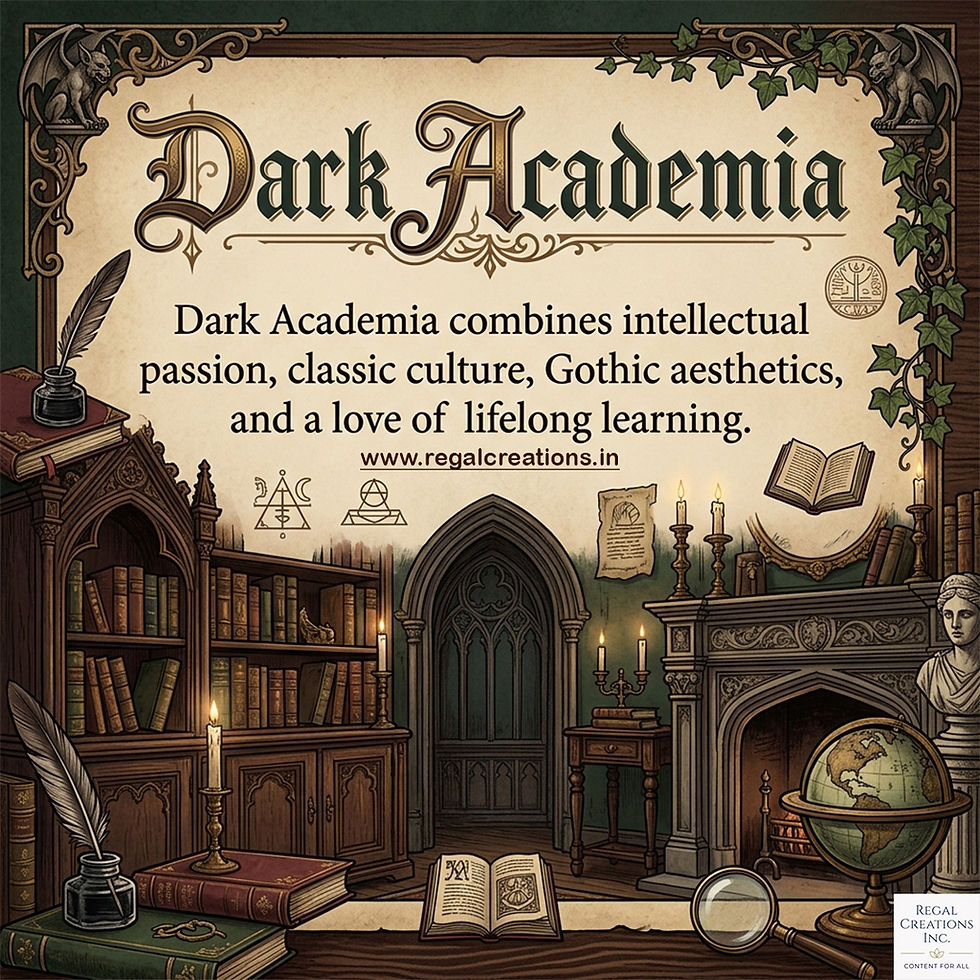
Dark Academia is an aesthetic and subculture inspired by classic literature, elite universities, intellectual pursuits, and a slightly melancholic, gothic atmosphere.
Key elements
📚 Old books, poetry, philosophy, and classical studies
🕯️ Dim libraries, candlelight, rainy weather, and historic buildings
🎻 Classical music and art
☕ Coffee, tea, handwritten notes, and long study sessions
🖤 A mood of mystery, nostalgia, ambition, and introspection
Fashion
Tweed blazers
Turtlenecks
Pleated skirts or tailored trousers
Loafers and oxfords
Neutral colors: brown, black, beige, gray, cream
Popular inspirations
The Secret History
If We Were Villains
Dead Poets Society
Historic universities such as University of Oxford and University of Cambridge
Dark Academia quote vibe
"A rainy afternoon, a stack of books, and the feeling that knowledge is both beautiful and dangerous."
Crafting gothic mysteries involves blending suspense, psychological tension, and dark atmospheric settings to create stories that feel both eerie and intellectually engaging. The genre combines the mystery of hidden truths with the emotional intensity of Gothic fiction.
Key Elements
1. Atmospheric Setting
The setting should feel almost like a character itself:
Ancient mansions, castles, monasteries, or secluded estates
Foggy moors, stormy coastlines, dense forests, or decaying towns
Dark corridors, hidden rooms, and secret passages
2. A Compelling Mystery
The central mystery often revolves around:
A suspicious death or disappearance
Family secrets and inherited curses
Lost manuscripts, portraits, or heirlooms
Strange supernatural events that may have rational explanations
3. Complex Characters
Include characters burdened by:
Guilt or trauma
Obsession and ambition
Forbidden love
Hidden identities and secret pasts
The protagonist is often an outsider who gradually uncovers disturbing truths.
4. Gothic Themes
Common themes include:
Madness versus sanity
The past haunting the present
Isolation and loneliness
Corruption beneath respectability
Fear of the unknown
5. Suspense and Psychological Horror
Build tension through:
Unexplained noises and sightings
Unreliable narrators
Cryptic letters and diaries
Dreams, visions, and unsettling coincidences
Influential Works
Jane Eyre
Rebecca
The Hound of the Baskervilles
The Turn of the Screw
Writing Formula
Setting + Secret + Suspicion + Revelation
For example:
A young historian arrives at a crumbling manor to catalog its library. As she discovers centuries-old letters hidden behind a wall, she uncovers evidence linking the estate's revered founder to a murder that was covered up generations ago.
A successful gothic mystery immerses readers in a world of shadows, secrets, and uncertainty, where every creaking floorboard and whispered rumor may conceal a clue. The atmosphere should be as captivating as the mystery itself.
Psychological thrillers are stories that focus on the complexities of the human mind, exploring fear, obsession, manipulation, paranoia, and the blurred line between reality and illusion. Rather than relying primarily on physical danger, they create suspense through mental and emotional tension.
Key Characteristics
1. Unreliable Narrators
The protagonist's perception may be distorted by:
Trauma
Memory loss
Mental illness
Deception
Readers are often left questioning what is real.
2. Psychological Conflict
The central tension arises from:
Internal struggles
Moral dilemmas
Obsessions
Hidden motives
The greatest threat may come from the character's own mind.
3. Suspense and Uncertainty
Psychological thrillers build tension through:
Secrets and lies
Manipulation and gaslighting
Twists and revelations
Constant uncertainty about whom to trust
4. Complex Characters
Characters are often:
Morally ambiguous
Emotionally damaged
Intelligent but flawed
Driven by fear, revenge, guilt, or desire
5. Mind Games
The plot frequently involves:
Deception
Double identities
Hidden agendas
Strategic psychological manipulation
Common Themes
Reality versus illusion
Identity and self-deception
Paranoia and mistrust
Memory and trauma
Obsession and control
Justice and revenge
Notable Examples
Gone Girl
The Girl on the Train
Black Swan
Shutter Island
Fight Club
Writing Formula
Character Flaw + Hidden Truth + Psychological Pressure + Twist
Example:
A successful psychiatrist begins receiving anonymous notes predicting her patients' actions. As the predictions come true, she discovers a connection to a forgotten event from her childhood, forcing her to question her own memories.
Psychological thrillers captivate audiences by turning the human mind into the primary battleground. Their power lies in making readers doubt reality, question motives, and experience the tension of unraveling hidden truths.
Psychological thrillers set within prestigious schools, universities, academies, or elite organizations combine intellectual ambition with secrets, power struggles, and psychological tension. The contrast between an institution's polished reputation and its hidden darkness creates a compelling atmosphere.
Why the Setting Works
High pressure: Students or members compete for status, recognition, and success.
Isolation: Campuses and academies often function as self-contained worlds.
Hierarchy: Professors, administrators, and elite groups wield significant influence.
Secrets: Traditions, exclusive societies, and institutional cover-ups create mystery.
Common Themes
Obsession with achievement
Academic rivalry
Class privilege and elitism
Manipulation by mentors
Identity and belonging
The cost of ambition
Typical Characters
The ambitious outsider
The charismatic professor
The brilliant but troubled student
The privileged heir
The secretive scholar
The manipulative friend group
Story Premise Example
A scholarship student enters a renowned university known for producing influential leaders. When a member of an exclusive academic society disappears, she uncovers a network of psychological manipulation, forged identities, and decades-old secrets hidden beneath the institution's prestigious image.
Notable Examples
The Secret History
If We Were Villains
The Talented Mr. Ripley
The Social Network
Prestigious settings amplify psychological thrillers by placing characters in environments where reputation, intellect, and power are everything. Beneath the elegant architecture and academic excellence often lie jealousy, deception, obsession, and dangerous secrets.
Historic collegiate environments refer to old, tradition-rich universities and colleges whose architecture, customs, and academic culture create a distinctive atmosphere of intellectual prestige, heritage, and timelessness. These settings are often associated with scholarly pursuits, elite education, and centuries-old traditions.
Defining Features
1. Architectural Grandeur
Gothic, Neo-Gothic, Georgian, or Victorian buildings
Stone courtyards and archways
Grand libraries and reading rooms
Chapels, clock towers, and historic halls
2. Academic Tradition
Long-standing rituals and ceremonies
Formal academic dress and gowns
Honors societies and scholarly clubs
Strong emphasis on classical learning
3. Intellectual Atmosphere
Deep engagement with literature, philosophy, history, and the arts
Culture of debate and inquiry
Preservation of archives, manuscripts, and rare books
4. Sense of History
Generations of students and faculty
Historical legends and campus folklore
Buildings and spaces tied to significant events
Cultural Appeal
Historic collegiate environments evoke:
Nostalgia for traditional scholarship
Intellectual curiosity
Ambition and achievement
Mystery and hidden histories
Aesthetic beauty and contemplation
Famous Examples
University of Oxford
University of Cambridge
Harvard University
Yale University
In Literature and Film
Historic colleges often serve as settings for:
Gothic mysteries
Psychological thrillers
Coming-of-age stories
Academic dramas
Dark Academia narratives
The atmosphere of ancient libraries, secret societies, and centuries-old traditions naturally lends itself to stories of discovery, ambition, and hidden secrets.
Historic collegiate environments blend architectural beauty, intellectual rigor, and cultural tradition, creating spaces where the past and present coexist. Their enduring appeal lies in their ability to inspire learning, reflection, and storytelling.
Real-World Examples of Historic Collegiate Environments
United Kingdom
University of Oxford
Founded in the 12th century.
Famous for its medieval colleges, libraries, and centuries-old traditions.
Frequently associated with Dark Academia aesthetics and academic fiction.
University of Cambridge
Founded in 1209.
Known for historic colleges, riverside courtyards, and Gothic architecture.
Home to numerous literary and scientific figures.
United States
Harvard University
Established in 1636.
Features historic brick buildings and a strong tradition of scholarship.
Symbolizes academic prestige worldwide.
Yale University
Renowned for its Collegiate Gothic architecture.
Often serves as inspiration for fictional elite universities.
Princeton University
Known for its ivy-covered Gothic campus and rich academic traditions.
Europe
University of Bologna
Founded in 1088 and often considered the world's oldest continuously operating university.
University of Salamanca
Founded in 1218.
Famous for its Renaissance architecture and scholarly heritage.
Heidelberg University
Germany's oldest university, with a strong intellectual legacy.
India
University of Calcutta
One of India's oldest modern universities, established in 1857.
Presidency University
Known for its colonial-era architecture and intellectual history.
Aligarh Muslim University
Rich academic traditions and distinctive Indo-Islamic architecture.
Banaras Hindu University
One of Asia's largest residential universities, blending tradition with scholarship.
Why These Settings Inspire Fiction
Historic universities provide:
Ancient libraries and archives
Secret societies and traditions
Academic competition and ambition
Architectural beauty mixed with mystery
A sense that the past still influences the present
These qualities make them ideal settings for Dark Academia, Gothic mysteries, and psychological thrillers such as The Secret History and If We Were Villains.
Examples of Dark Academia
Dark Academia is expressed through literature, films, fashion, architecture, and lifestyle. It romanticizes learning, classical knowledge, old libraries, and the pursuit of intellectual excellence, often with themes of mystery, ambition, and melancholy.
Literature
The Secret History – A group of elite classics students become entangled in murder and guilt.
If We Were Villains – Shakespeare students at an elite arts college are drawn into a tragedy.
The Picture of Dorian Gray – Beauty, decadence, and moral corruption.
Frankenstein – Intellectual ambition and its consequences.
Jane Eyre – Gothic atmosphere, mystery, and introspection.
Films
Dead Poets Society
Kill Your Darlings
The Theory of Everything
The Ninth Gate
The Talented Mr. Ripley
Architecture & Settings
University of Oxford
University of Cambridge
Yale University
Historic libraries, ivy-covered colleges, and Gothic cathedrals.
Fashion
Tweed blazers
Wool coats
Turtlenecks
Pleated skirts
Oxford shoes and loafers
Neutral tones: brown, black, beige, gray
Lifestyle Examples
Reading classical literature and philosophy
Taking notes in leather-bound journals
Spending hours in libraries or museums
Listening to classical music
Drinking coffee or tea while studying on rainy afternoons
Learning Latin, Greek, or other classical subjects
Common Themes
Intellectual curiosity
Obsession with knowledge
Academic competition
Beauty and tragedy
Nostalgia for the past
Mystery and hidden secrets
Dark Academia is more than a visual aesthetic; it is a fascination with learning, literature, history, and the emotional intensity of intellectual life. Its appeal comes from blending scholarship, beauty, ambition, and mystery into a distinctive cultural style.
Conclusion on Dark Academia
Dark Academia is a cultural and aesthetic movement that romanticizes learning, literature, history, and intellectual curiosity within atmospheric settings such as old libraries, historic universities, and Gothic architecture. While it celebrates knowledge, creativity, and scholarly ambition, it also explores deeper themes of obsession, isolation, perfectionism, and the pursuit of meaning. Its enduring appeal lies in its blend of beauty, mystery, nostalgia, and a fascination with the life of the mind.
Thanks for reading!!!!!!


Comments