Art Blogs
- Manyanshi Joshi
- Jul 20, 2025
- 7 min read

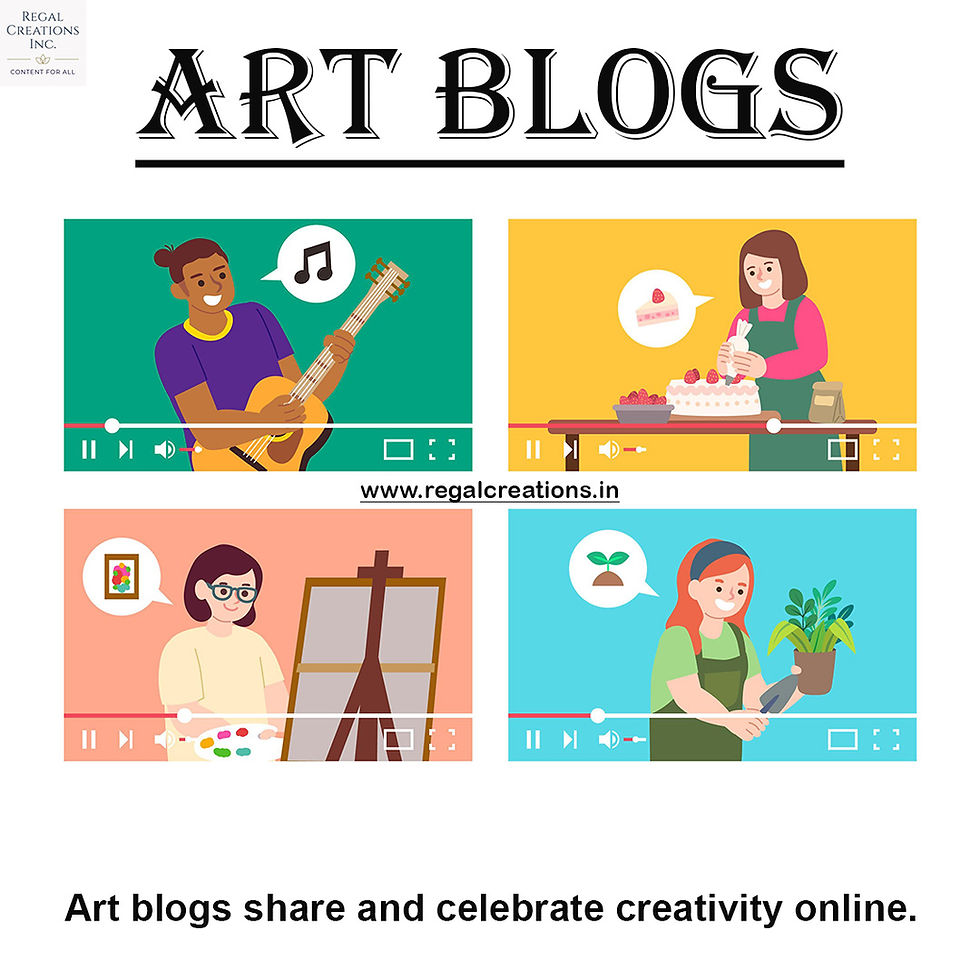
Art blogs are websites or online platforms where individuals or organizations publish content related to art and the art world. These blogs can cover a wide range of topics depending on the focus of the writer or curator. Here's a breakdown of what art blogs typically include:
🔍 Common Features of Art Blogs
Art Reviews – Critiques and analysis of exhibitions, artworks, or artist portfolios.
Artist Spotlights – Interviews, profiles, or features on both emerging and established artists.
Art History & Theory – Articles exploring historical movements, famous works, and theoretical frameworks.
Creative Process – Behind-the-scenes looks at how artists create their work, including sketches, materials, and techniques.
Art News – Updates on events, gallery openings, museum exhibitions, and art market trends.
Tutorials & DIYs – Guides on how to create art, from beginner-friendly projects to advanced techniques.
Personal Reflections – Artists or writers sharing their thoughts, inspirations, or journeys through art.
🖌️ Types of Art Blogs
Professional blogs: Run by critics, galleries, or art institutions.
Personal blogs: Run by artists or art lovers sharing their work or opinions.
Niche blogs: Focused on specific genres like digital art, street art, abstract art, or even art therapy.
📌 Examples of Well-Known Art Blogs
Colossal – Focuses on contemporary art, design, photography, and visual culture.
Juxtapoz – Covers street art, lowbrow, and underground artists.
Hyperallergic – Offers critical perspectives on contemporary art and culture.
There are many tools available to create art, both traditional and digital. Here's a categorized list to help you understand what tools are commonly used:
🎨 Traditional Art Tools
✏️ Drawing
Pencils (graphite, charcoal)
Pens & ink
Markers (alcohol-based like Copic, or water-based)
Erasers (kneaded, vinyl)
🖌️ Painting
Paints (Acrylic, Oil, Watercolor, Gouache)
Brushes (various shapes & sizes)
Palettes
Canvases, paper, or wood panels
Easels
✂️ Mixed Media & Crafts
Collage materials (magazines, photos)
Glue, scissors, X-Acto knives
Fabric, yarn, and thread
Clay (air-dry, polymer, ceramic)
💻 Digital Art Tools
🧑💻 Software
Adobe Photoshop – Digital painting, photo editing
Adobe Illustrator – Vector-based art
Procreate – Popular iPad app for drawing and painting
Corel Painter – Realistic brush simulation
Krita – Free and open-source digital painting software
Clip Studio Paint – Great for comics, manga, and illustration
Blender – 3D modeling and animation
Canva – Simplified design for beginners (graphic design focus)
🖱️ Hardware
Drawing tablets (e.g., Wacom, Huion, XP-Pen)
iPad + Apple Pencil
Touchscreen laptops with stylus support
Desktop PC or Mac for intensive tasks like 3D rendering
🛠️ AI & Experimental Tools
DALL·E – AI-generated images from text prompts
Runway ML – AI tools for artists, designers, and filmmakers
Artbreeder – AI for creating generative portraits and art
Deep Dream – Surreal AI-processed images
There are many inspiring and influential art teachers across history and online today, each with their own teaching style and artistic specialty. Here’s a list broken down into historical icons, modern influencers, and online favorites:
🎨 Famous Art Teachers in History
These artists were also known for teaching and mentoring others.
1. Leonardo da Vinci
Taught through sketchbooks and apprenticeships.
Inspired generations with his studies of anatomy, proportion, and form.
2. Johannes Itten
Taught at the Bauhaus.
Known for his color theory, which is still taught in design schools today.
3. Josef Albers
Taught at Black Mountain College and Yale.
His book “Interaction of Color” is a classic in color education.
4. Robert Henri
American painter and teacher, author of “The Art Spirit.”
Encouraged personal expression and authenticity in art.
💻 Popular Online Art Teachers (YouTube / Courses)
1. Proko (Stan Prokopenko)
Focus: Figure drawing, anatomy, portraiture
Platform: YouTube & Proko.com
Known for: Clear lessons, humor, and professional-level content
2. Aaron Blaise
Former Disney animator (The Lion King, Brother Bear)
Teaches: Character design, animation, digital painting
Platform: CreatureArtTeacher.com
3. Marco Bucci
Focus: Painting fundamentals, digital art, color and light
Platform: YouTube
Known for: Insightful breakdowns of painting techniques
4. James Gurney
Illustrator of Dinotopia
Teaches: Plein air painting, traditional techniques, color theory
Platform: YouTube & Blog
5. Ahmed Aldoori
Teaches: Digital painting, anatomy, creativity
Platform: YouTube & Gumroad
Great for: Beginners and aspiring concept artists
👩🏫 Modern Art Educators & Mentors
Glen Vilppu – Master figure drawing instructor, widely respected in animation and classical art training.
Bobby Chiu – Co-founder of Schoolism; teaches concept art and creature design.
Shaddy Safadi – Industry professional and founder of One Pixel Brush; excellent for environment and game design.
Interviews with other artists are a valuable way to learn about the creative process, career paths, inspirations, and challenges that artists face. They can be found in blogs, magazines, podcasts, YouTube channels, and art books.
Here's how to access and even create your own artist interviews:
🎤 Where to Find Artist Interviews
📚 Websites & Blogs
Juxtapoz Magazine – Features interviews with street and contemporary artists.
Colossal – Often includes Q&A-style features with innovative artists.
Hi-Fructose – Showcases emerging and alternative artists.
Art Station Blog – Spotlights digital artists, game designers, and illustrators.
Hyperallergic – Covers fine art, activism, and in-depth interviews with artists and curators.
🎧 Podcasts
Art Curious – Art history with occasional artist interviews.
Savvy Painter – Interviews with contemporary painters on technique and career advice.
Creative Pep Talk (Andy J. Pizza) – Talks to artists and designers about staying inspired.
Draftsmen Podcast (by Stan Prokopenko & Marshall Vandruff) – Offers interviews and insight on art education.
📺 YouTube Channels
Proko – Includes interviews with art professionals and masters.
Schoolism – Deep dives with world-class digital and concept artists.
James Gurney – Traditional art with conversations and painting demos.
The Art of Aaron Blaise – Sometimes features interviews or collaborations.
🧠 What You Can Learn From Artist Interviews
Their artistic journey and education.
How they overcome creative blocks.
Tools and techniques they prefer.
How they manage the business side of art (pricing, galleries, commissions).
Their influences, philosophies, and values.
✍️ Want to Do Your Own Artist Interviews?
Here’s how to get started:
Reach out to artists via Instagram, email, or art communities.
Prepare questions such as:
What inspires your work?
What does your creative process look like?
What’s a challenge you’ve faced as an artist?
How do you balance personal work and commissions?
Publish the interview on your blog, social media, or YouTube.
Add visuals: show their artwork alongside the interview.
DIY art projects are a great way for beginners to explore creativity without needing fancy tools or training. Here’s a list of easy, fun, and budget-friendly art projects you can try—even if you’re just starting out:
🎨 DIY Art Projects for Newbies
1. Abstract Acrylic Pouring
What you need: Acrylic paints, pouring medium, canvas, cups
Why it's great: No drawing skills needed. Just mix and pour!
Tip: Protect your workspace—it gets messy (but fun!).
2. Watercolor Galaxy
What you need: Watercolor paints, thick paper, brush, water
Why it's great: Easy techniques with beautiful results.
Bonus: Add stars with white gel pens or a toothbrush + white paint.
3. Paper Collage Art
What you need: Old magazines, glue, scissors, paper
Why it's great: Great for exploring color and composition.
Theme ideas: Nature, emotions, dreams, or your favorite quote.
4. Stencil & Spray Art
What you need: Stencils (store-bought or homemade), spray paint or sponge & paint
Why it's great: Fast and satisfying results with minimal effort.
5. Doodle Art or Zentangles
What you need: Pen, paper
Why it's great: Meditative and easy. Just fill spaces with repeating patterns.
Try this: Start with a shape (heart, star, hand outline) and fill it with doodles.
6. Tissue Paper "Stained Glass"
What you need: Black paper, tissue paper, glue, scissors
Why it's great: Looks beautiful on windows. Easy and colorful!
7. Painted Rocks
What you need: Smooth rocks, acrylic paint or markers
Ideas: Flowers, mandalas, cartoon faces, positive quotes
8. Toilet Paper Roll Sculptures
What you need: Empty rolls, glue, scissors, paint
Why it's great: Eco-friendly + fun! Make animals, characters, or abstract shapes.
9. DIY Bookmarks
What you need: Cardstock, pens, markers, stickers, washi tape
Why it's great: Practical and fun to personalize or gift.
10. Salt & Watercolor Art
What you need: Watercolor, salt, watercolor paper
How it works: Paint a wet area, sprinkle salt, and watch the texture appear!
🧰 Basic Supplies to Keep on Hand:
Watercolors or acrylic paints
Brushes and sponges
Sketchbook or mixed media paper
Glue and scissors
Markers, pens, and pencils
Recyclables (magazines, cardboard, paper rolls)
There are countless incredible art museums around the world, each with its own focus and collection. Here’s a list of favorite and most famous art museums, grouped by region and known for inspiring artists of all levels:
🌍 World-Famous Art Museums
🇫🇷 Louvre Museum (Paris, France)
Home to the Mona Lisa, Venus de Milo, and thousands of iconic works.
World’s largest and most visited art museum.
Must-see for lovers of classical and Renaissance art.
🇬🇧 Tate Modern (London, UK)
Focuses on modern and contemporary art.
Hosts works by Picasso, Warhol, Rothko, and more.
Known for bold exhibitions and installations.
🇺🇸 The Met – Metropolitan Museum of Art (New York, USA)
Huge, encyclopedic collection from ancient to modern art.
Arms & armor, Egyptian art, European masterpieces, and more.
🇪🇸 Museo del Prado (Madrid, Spain)
Masterpieces by Goya, Velázquez, and El Greco.
A must-see for fans of Spanish and classical European art.
🇺🇸 Top Art Museums in the United States
🎨 Museum of Modern Art (MoMA) – New York
Home to Van Gogh’s Starry Night, Dali, Matisse, Pollock.
Amazing for modernism, abstraction, and photography.
🖼️ Art Institute of Chicago
Famous for Seurat’s A Sunday Afternoon, Grant Wood’s American Gothic.
Strong collection of Impressionist and American art.
🏛️ Getty Center – Los Angeles
European art, stunning architecture, and gardens.
Free admission, amazing views, and rotating exhibitions.
🌐 Other Notable Global Museums
🇮🇹 Uffizi Gallery (Florence, Italy)
Botticelli’s The Birth of Venus, da Vinci, Michelangelo.
Ideal for Renaissance lovers.
🇯🇵 The National Museum of Modern Art (Tokyo, Japan)
Rich in Japanese modern art and global influences.
Minimalist design and unique contemporary pieces.
🇳🇱 Rijksmuseum (Amsterdam, Netherlands)
Dutch masters: Rembrandt, Vermeer, and Frans Hals.
Features the Night Watch and The Milkmaid.
🎧 Can’t Travel? Try Virtual Tours!
Many of these museums offer free virtual tours:
Google Arts & Culture
Each museum’s website often has 360° views and digitized collections.
🎨 Conclusion: Art Blogs
Art blogs are a powerful and accessible way to explore, share, and grow in the world of art—whether you're an artist, student, or simply an admirer of creativity. They offer:
🖼️ Inspiration through artist spotlights and galleries
📚 Education via tutorials, theory, and expert tips
🎤 Connection through interviews and community engagement
📰 Updates on trends, exhibits, and industry news
✍️ Expression for artists to document and share their own creative journeys
Whether you're reading or writing one, an art blog is a gateway to creative discovery, conversation, and continuous learning.
Thanks for reading!!


Comments