Student debt

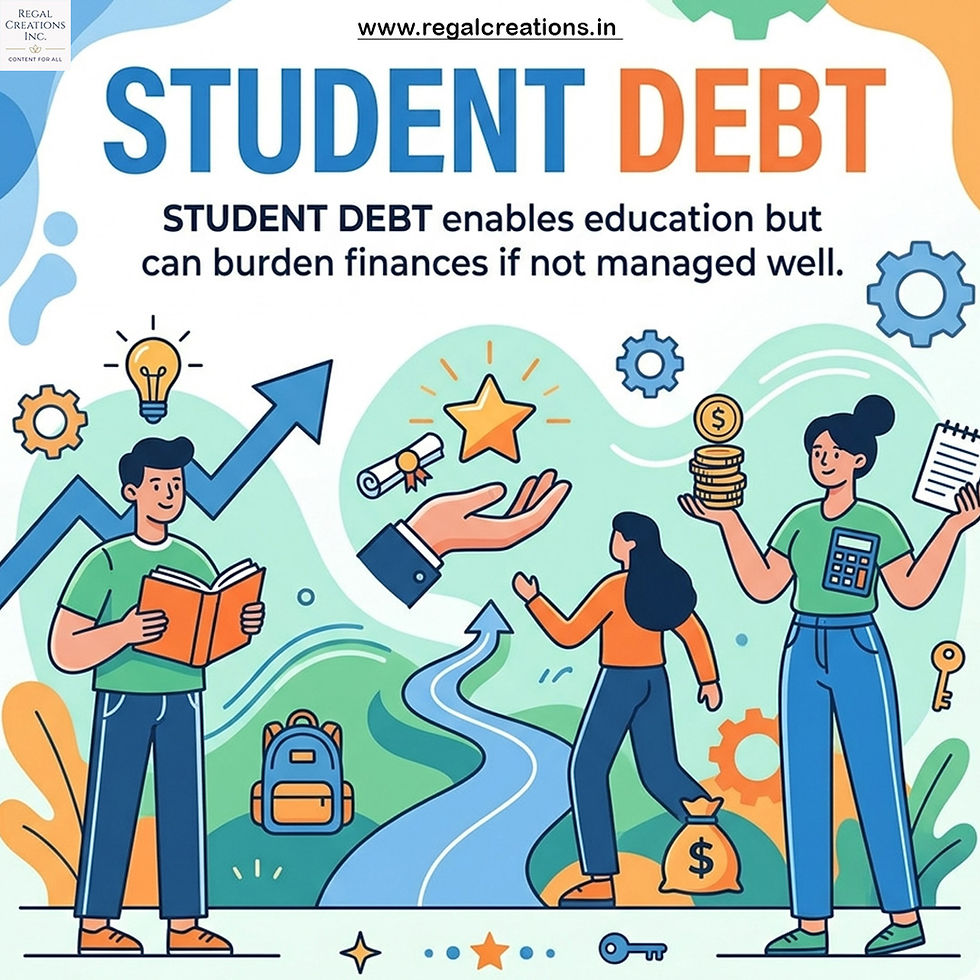
Student debt has become a defining financial and social issue in many countries, especially where higher education costs have risen faster than incomes. Its impact shows up not just in personal finances, but across the broader economy and even mental health.
Financial pressure on individuals Graduates often begin their careers already owing significant amounts, which can delay major life decisions. People with student debt are more likely to postpone buying a home, starting a business, or even saving for retirement. A large portion of their early income goes toward loan repayment, limiting financial flexibility.
Career choices and mobility Debt can influence what jobs people take. Instead of pursuing lower-paying but meaningful careers (like teaching or social work), many feel pushed toward higher-paying roles just to manage repayments. This can reduce diversity in certain professions and create long-term dissatisfaction.
Mental health effects There’s a strong link between high debt and stress, anxiety, and even depression. The constant pressure of repayment—especially when paired with uncertain job prospects—can weigh heavily, particularly on younger graduates.
Economic ripple effects When large numbers of young adults are focused on paying off debt, consumer spending can decrease. This affects industries like housing, retail, and travel. Over time, high student debt levels can slow overall economic growth.
Inequality concerns Student debt tends to hit lower- and middle-income students harder. Those without family financial support often borrow more, which can widen existing wealth gaps. In some cases, debt reinforces cycles of inequality rather than helping people move upward.
Potential upsides (often overlooked)It’s not entirely negative—student loans can make higher education accessible to people who otherwise couldn’t afford it. Education still tends to increase lifetime earnings on average, so borrowing can be an investment, though the risks have grown.
There’s no single fix for student debt—effective solutions usually combine cost control, smarter lending, and better repayment systems. Here are the main policy directions, with what they solve and the trade-offs involved.
1) Control the cost of education (root cause)
Idea: Cap tuition increases, expand public funding, and push institutions to be more cost-efficient. How it helps: Reduces the need to borrow in the first place. Examples: Many European countries heavily subsidize universities, keeping fees low or near-zero. Trade-off: Requires sustained government spending or reallocation from other areas.
2) Income-Driven Repayment (IDR)
Idea: Tie loan payments to a borrower’s income, with lower payments during low-earning years and possible forgiveness after a set period. How it helps: Prevents financial distress and defaults. Trade-off: Can increase the total amount repaid over time and shift costs to taxpayers if large portions are forgiven.
3) Targeted loan forgiveness
Idea: Cancel some or all debt for specific groups—such as low-income borrowers, public service workers, or those defrauded by institutions. How it helps: Provides immediate relief to the most burdened. Trade-off: Expensive and politically controversial; critics argue it may be unfair to those who already repaid loans.
4) Expand grants and scholarships
Idea: Replace loans with need-based grants wherever possible. How it helps: Reduces reliance on debt, especially for disadvantaged students. Trade-off: Requires public funding or private endowments; may not fully cover rising costs.
5) Improve transparency and accountability
Idea: Require institutions to disclose outcomes—graduation rates, employment data, average salaries by program. How it helps: Students make more informed decisions about whether a degree is worth the cost. Trade-off: Data collection can be complex, and outcomes vary widely by field and region.
6) Regulate or limit predatory practices
Idea: Crack down on institutions or lenders that mislead students or offer low-value degrees with high debt burdens. How it helps: Protects students from taking on debt that won’t pay off. Trade-off: Requires strong regulatory oversight and enforcement.
7) Encourage alternative education pathways
Idea: Invest in vocational training, apprenticeships, and shorter certification programs. How it helps: Offers lower-cost routes to stable employment without large loans. Trade-off: Social perceptions often still favor traditional degrees, and not all careers fit these pathways.
8) Employer and public-service incentives
Idea: Offer loan repayment assistance for employees or expand public-service loan forgiveness programs. How it helps: Reduces debt while guiding talent into needed sectors like healthcare, education, or government. Trade-off: Can create uneven benefits across professions.
9) Interest rate reforms
Idea: Lower interest rates on student loans or subsidize interest during study and early career years. How it helps: Prevents debt from ballooning over time. Trade-off: Reduces government or lender revenue.
10) One-time or periodic debt relief
Idea: Broad cancellation of a portion of student debt. How it helps: Immediate economic stimulus and relief. Trade-off: Doesn’t address the underlying cost problem, so debt can build up again.
Big picture
The most effective approach is usually a combination:
Lower upfront costs
Safer borrowing systems
Flexible repayment
Stronger accountability for institutions
Without tackling the cost of education itself, policies that only reduce or forgive debt tend to be temporary fixes.
India’s student debt situation is quite different from countries like the U.S.—tuition is generally lower at public institutions, but access, quality gaps, and employability are bigger challenges. So the most effective solutions in India focus less on mass debt cancellation and more on affordability, outcomes, and financing design.
Here’s how policy ideas translate specifically to India:
1) Strengthen public universities and control costs
Institutions like University Grants Commission (UGC) already regulate fees in many public universities, but funding is often tight.
Policy direction:
Increase government funding to public colleges and state universities
Expand capacity in high-demand fields (engineering, healthcare, data science)
Prevent steep fee hikes in professional courses
Why it matters in India: A large share of students rely on public institutions. Keeping them strong reduces the need for loans altogether.
2) Expand targeted scholarships (not just loans)
Schemes like the National Scholarship Portal already exist, but awareness and coverage are uneven.
Policy direction:
Increase need-based scholarships for low-income students
Streamline application and disbursement systems
Target underrepresented groups (rural, first-generation learners)
Impact: Reduces dependence on education loans, especially for vulnerable groups.
3) Reform education loans (access + terms)
Education loans in India are often provided by public sector banks under frameworks like the Model Education Loan Scheme.
Problems today:
Collateral requirements for larger loans
High interest rates for some borrowers
Repayment stress if job outcomes are weak
Policy direction:
Expand collateral-free loans for a wider income range
Offer interest subsidies during study and job search
Introduce income-linked repayment (still limited in India)
4) Link education to employability
A major issue in India is not just debt—but graduates without strong job prospects.
Initiatives like Skill India Mission aim to address this.
Policy direction:
Tie funding or accreditation to job placement outcomes
Strengthen industry–university partnerships
Embed internships and practical training in degrees
Impact: If graduates earn more reliably, debt becomes manageable.
5) Expand vocational and alternative pathways
Programs under Pradhan Mantri Kaushal Vikas Yojana promote skill-based training.
Policy direction:
Normalize non-degree career paths (diplomas, certifications)
Invest in high-quality Industrial Training Institutes (ITIs)
Align training with local job markets
Why it matters: Not every student needs a 3–4 year degree—and avoiding unnecessary degrees reduces debt risk.
6) Better data transparency for students
Many students take loans for degrees without clear information on outcomes.
Policy direction:
Publish college-level data: placement rates, median salaries, dropout rates
Create a centralized “return on education” dashboard
Impact: Students can make more informed borrowing decisions.
7) Regulate private institutions more tightly
Private colleges account for a large share of higher education in India, especially in engineering and management.
Policy direction:
Cap fees in certain programs
Enforce quality standards through bodies like All India Council for Technical Education (AICTE)
Penalize misleading placement claims
Impact: Prevents students from taking on debt for low-value degrees.
8) Targeted loan forgiveness (limited use)
Unlike the U.S., widespread loan cancellation isn’t as central in India because:
Total debt levels are lower
Fewer students borrow overall
Better approach:
Offer relief for distressed borrowers (e.g., long-term unemployment, fraud cases)
Expand repayment support for public service jobs (teachers, rural doctors)
9) Digital and low-cost education expansion
Online platforms and hybrid learning can reduce costs significantly.
Policy direction:
Scale government-backed platforms like SWAYAM
Integrate online credits into formal degrees
Impact: Lower cost per student → less borrowing needed.
Big picture for India
The most effective strategy is not mass debt relief, but a three-part balance:
Keep education affordable (especially public institutions)
Ensure degrees lead to real jobs
Make loans safer and more flexible
India’s challenge isn’t just “too much debt”—it’s making sure that borrowing for education actually pays off.
Student debt is not just a financial issue—it sits at the intersection of education, employment, and social mobility. In countries like the U.S., it has become a large-scale economic burden, while in India it is a more targeted but still serious challenge, shaped by access gaps and uneven job outcomes.
The core problem isn’t simply that students borrow money—it’s when the cost of education outpaces the value it delivers. When degrees lead to stable, well-paying jobs, student loans can function as a useful investment. But when education is expensive, poorly aligned with the job market, or inaccessible without heavy borrowing, debt becomes a long-term constraint on individuals’ lives.
In the Indian context, institutions and regulators like the University Grants Commission and All India Council for Technical Education play a crucial role in maintaining quality and affordability. Combined with initiatives such as Skill India Mission, the focus is shifting toward improving employability rather than simply expanding access.
Ultimately, the most sustainable solution is a balanced system where:
Education remains affordable and accessible
Students make informed choices
Loans are fair, flexible, and limited in risk
And most importantly, education leads to real economic opportunity
When these elements align, student debt becomes manageable and purposeful. When they don’t, it risks reinforcing inequality and slowing both personal and national progress.
Thanks for reading!!!!


Comments