Short blog series (part76) Investing for non-experts

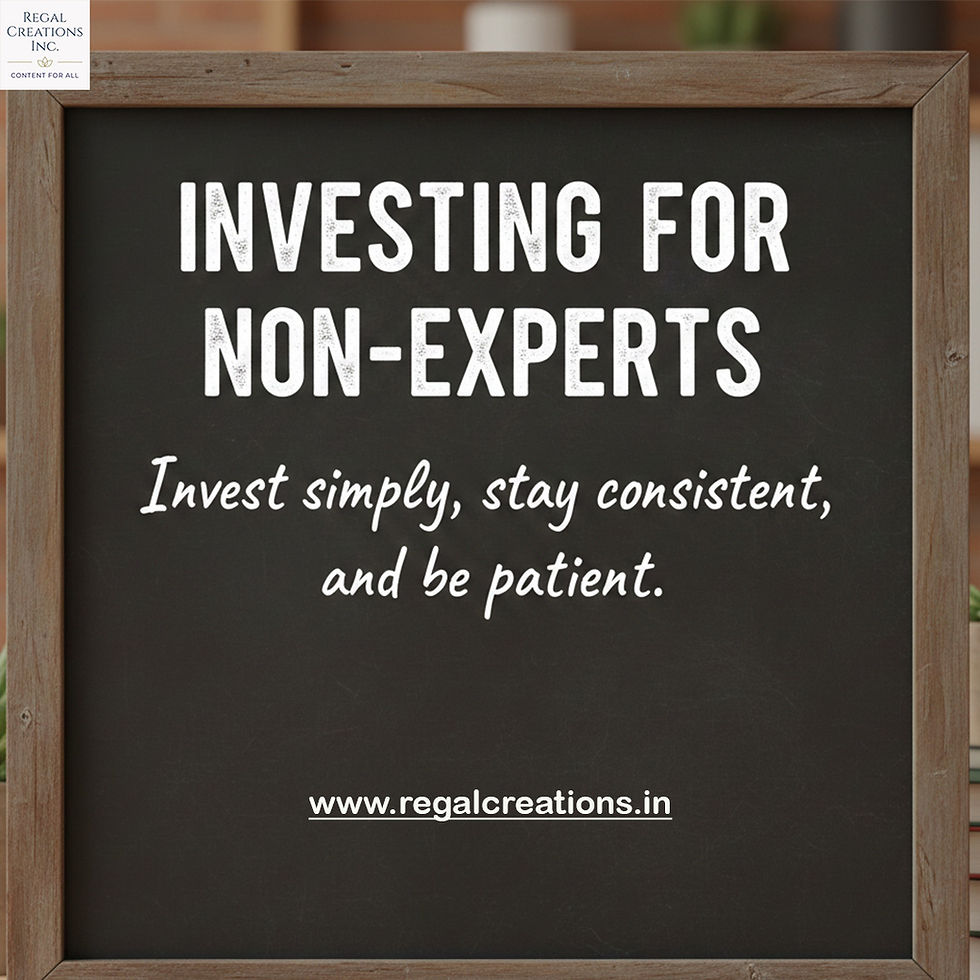
Investing = putting your money to work so it grows over time, instead of just sitting there losing value to inflation.
You’re not trying to get rich quick. You’re trying to own tiny pieces of productive stuff and let time do the heavy lifting.
Step 1: Don’t invest money you’ll need soon
Before anything else:
Emergency fund: ~3–6 months of expenses in cash
Money you’ll need in the next 1–3 years → keep it safe (savings account)
Investing is for long-term money (5+ years).
Step 2: Understand the main investment types (very simply)
🏢 Stocks (shares)
You own a piece of a company.
Pros: Highest long-term growth
Cons: Prices go up and down a lot in the short term
Think: “I believe businesses will grow over decades.”
📦 ETFs (Exchange-Traded Funds)
A basket of many stocks bundled together.
One purchase = hundreds or thousands of companies
Lower risk than picking individual stocks
Perfect for beginners
Think: “I don’t want to guess winners.”
💵 Bonds
You’re lending money and getting paid interest.
More stable, lower growth
Helps smooth out big market swings
Think: “I want less drama.”
🏠 Real estate
Property or real-estate funds.
Can generate income
Less liquid, more effort
Think: “I’m okay being hands-on.”
Step 3: The beginner-proof strategy
This is the part most non-experts should stop at—and that’s a good thing.
✅ Use broad, low-cost ETFs
Examples (conceptually, not recommendations):
Total stock market
Global stock market
Stock + bond mix
Why this works:
Diversification (you’re not betting on one thing)
Low fees (fees quietly kill returns)
Historically strong long-term growth
This is how boring investing beats exciting investing.
Step 4: Invest regularly, ignore the noise
Invest a fixed amount every month (automatic if possible)
Markets go up → invest
Markets go down → also invest
News is loud, long-term trends are quiet
This is called dollar-cost averaging, but you don’t need to remember the name—just the habit.
Step 5: Things to actively avoid
🚫 Day trading🚫 “Guaranteed” returns🚫 Hot tips from friends / TikTok / group chats🚫 Checking your portfolio every day
If it feels like gambling, it probably is.
Step 6: Time is your secret weapon
Two huge forces work for you:
Compound growth (money earning money)
Time in the market, not timing the market
Even small amounts matter if you start early and stay consistent.
A super simple starter setup (example mindset)
“I invest X every month into a broad ETF, reinvest dividends, and don’t touch it for years.”
That’s it. That’s the whole play.
The key thing people miss
“ETF,” “mutual fund,” and “index fund” are NOT three separate investments.
They answer different questions:
ETF vs Mutual Fund → How is it bought and sold?
Index fund vs Active fund → How is it managed?
Once you see that, everything clicks.
1️⃣ Index funds (what it invests in)
An index fund just means:
“This fund automatically follows a list (index) of companies.”
Examples of indexes:
S&P 500 (big U.S. companies)
Total stock market
Global stock market
Why people love index funds
No human guessing
Very low fees
Historically outperform most “experts” over time
📌 Important: An index fund can be either an ETF or a mutual fund.
“Index fund” ≠ a product you buy It’s a strategy.
2️⃣ ETFs (how you buy it)
ETF = Exchange-Traded Fund
Think of it like a stock-shaped fund.
How ETFs work
Trade on the stock market
You buy/sell during the day
Price changes in real time
Why ETFs are popular
Easy to buy
Usually low fees
Very tax-efficient
No minimum investment (besides share price)
📌 Most beginner-friendly investing today uses index ETFs.
3️⃣ Mutual funds (another way to buy a fund)
Mutual funds are the older cousin of ETFs.
How mutual funds work
You buy/sell once per day (after market close)
Price is set once daily
Often require a minimum investment
Pros
Can invest exact dollar amounts
Automatic investing is easy
Simple for long-term set-it-and-forget-it
Cons
Often higher fees
Less tax-efficient
Fewer choices nowadays
Putting it together (this is the “aha”)
You can have:
✅ Index ETF (most common recommendation)
✅ Index mutual fund
❌ Actively managed ETF
❌ Actively managed mutual fund
So the best combo for most non-experts is usually:
Index + ETF
Side-by-side cheat sheet
Feature | ETF | Mutual Fund |
Bought like a stock? | Yes | No |
Trades during the day? | Yes | No |
Minimum investment | Price of 1 share | Often $1k–$3k |
Fees | Usually very low | Often higher |
Tax efficiency | High | Lower |
Beginner friendly | ⭐⭐⭐⭐ | ⭐⭐⭐ |
The ultra-simple rule of thumb
If you want to keep life easy:
Long-term investing → Index ETFs
Hands-off retirement account → Index mutual funds (if available cheaply)
Avoid high-fee active funds unless you really know why you’re choosing them
One-liner summaries (memory-friendly)
Index fund: What it follows
ETF: How you buy it
Mutual fund: An older buying method
Real-world examples (conceptual, not advice)
🟢 Example 1: “Own basically the entire stock market”
What it is: A total market index fund
What’s inside:
Thousands of companies
Big ones, small ones, boring ones, exciting ones
Tech, healthcare, finance, retail, everything
Why people use it:
Maximum diversification
No guessing winners
“I believe capitalism keeps chugging along”
Format you’ll see it in:
As an ETF or a mutual fund
Almost always an index fund
🧠 Mental model:
“If the overall economy grows over decades, I win.”
🟢 Example 2: “Just the big, famous companies”
What it is: A large-company index fund (like an S&P-style fund)
What’s inside:
~500 of the largest companies
Names you recognize (but you’re not choosing them individually)
Why people use it:
Strong historical growth
Simple and popular
Slightly more concentrated than total market
Format:
Common as both ETFs and mutual funds
🧠 Mental model:
“I want the heavy hitters doing most of the work.”
🟢 Example 3: “Not just one country”
What it is: A global stock index fund
What’s inside:
U.S. companies
International companies
Developed + emerging markets
Why people use it:
Reduces reliance on one country
Global diversification with one purchase
Format:
Often an ETF
Almost always indexed
🧠 Mental model:
“I don’t know which country will dominate long-term, so I own them all.”
🟢 Example 4: “Growth with less emotional whiplash”
What it is: A stock + bond index fund (balanced fund)
What’s inside:
Stocks for growth
Bonds for stability
Why people use it:
Smaller ups and downs
Easier to stick with during crashes
Good for people who hate volatility
Format:
Common as mutual funds
Increasingly available as ETFs
🧠 Mental model:
“I want returns, but I also want to sleep.”
What none of these require
🚫 Picking companies🚫 Timing the market🚫 Watching financial news🚫 Knowing what the Fed is doing this week
You’re not saying:
“I think Company X will win.”
You’re saying:
“I think markets will grow over time.”
A very typical non-expert setup (example)
Not a recommendation — just illustrating how people think:
1 broad stock index fund or
1 global stock index fund or
1 stock + bond index fund
That’s it. No juggling. No rotating. No “rebalancing spreadsheets at midnight.”
How to sanity-check any fund you see
When you look one up, ask:
Is it indexed? (follows a known index)
Is it broad? (hundreds or thousands of holdings)
Are fees low? (small % number)
Do I understand it in one sentence?
If yes → it’s probably in the “boring but effective” category.
Clean conclusion for Investing for non-experts—no hype, no homework.
The takeaway (if you remember nothing else)
You don’t need:
Stock-picking skills
Market predictions
Financial news
Fancy strategies
You need three things: time, consistency, and boredom tolerance.
The non-expert investing formula
Use broad, low-cost index funds(often as ETFs, sometimes as mutual funds)
Diversify by default Own many companies, not a few guesses
Invest regularly Same amount, same schedule, automated if possible
Leave it alone Markets wobble; long-term growth doesn’t care
What “success” actually looks like
Not excitement. Not constant tweaking. Not “beating the market.”
Success looks like:
Quiet compounding
Fewer decisions
Ignoring most financial noise
Letting decades do the work
Boring wins.
The biggest mistake non-experts make
Trying to act like experts.
More complexity usually means:
Higher fees
More stress
Worse results
Simplicity isn’t settling — it’s strategy.
One-sentence philosophy
Own the market, keep costs low, invest consistently, and give it time.
That’s the whole game.
Thanks for reading!!!!


Comments