Overcoming Procrastination
- Manyanshi Joshi
- Mar 5, 2025
- 15 min read

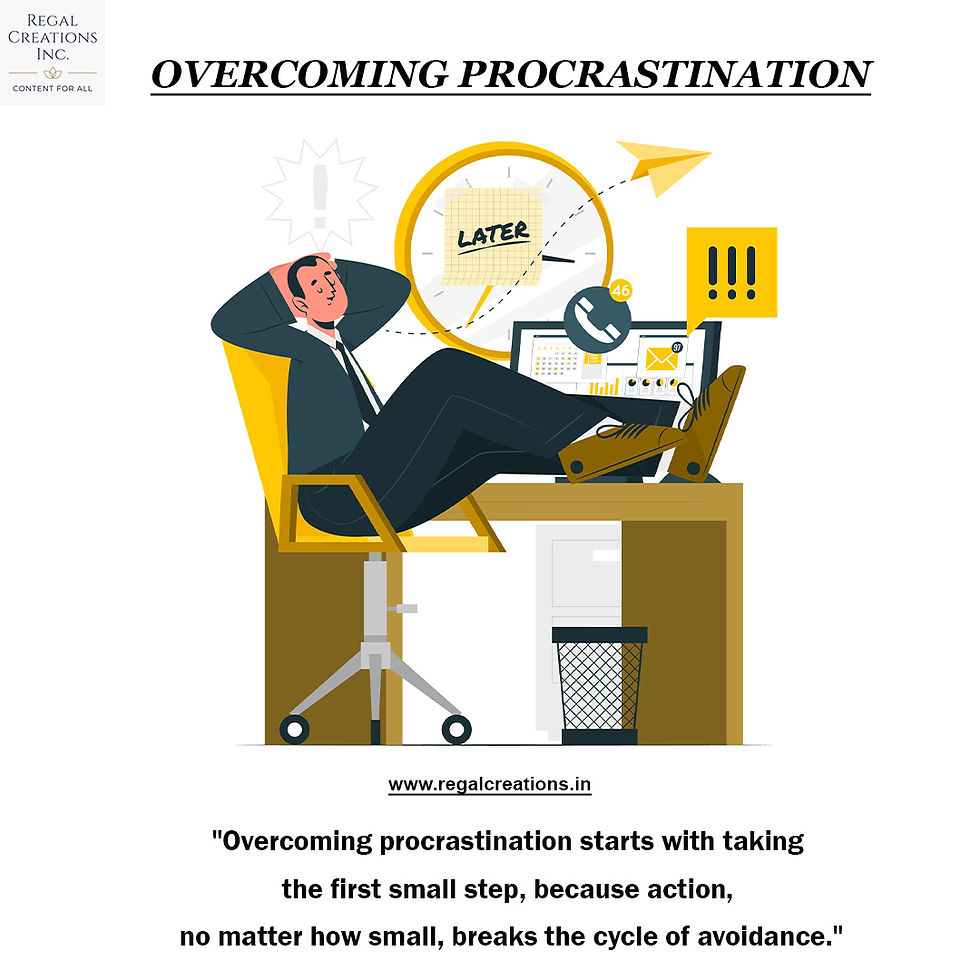
Overcoming procrastination can be tough, but it's definitely possible! Here are some strategies you can try to beat procrastination:
1. Break Tasks into Smaller Steps
Why it works: Large tasks can feel overwhelming. Breaking them down into smaller, more manageable chunks makes it easier to get started and build momentum.
How to do it: If you’re working on something big, write out all the individual steps and focus on completing one small task at a time.
2. Use the "2-Minute Rule"
Why it works: Sometimes, the hardest part is just getting started. If a task will take less than two minutes, do it immediately.
How to do it: If the task feels small enough to do in two minutes, do it right away. This helps overcome the mental barrier of starting.
3. Set Clear and Achievable Goals
Why it works: Clear goals give you something to aim for, making it easier to focus and prioritize your work.
How to do it: Set specific, measurable, and time-bound goals. For example, “I will write 500 words in the next 30 minutes” is better than just “I’ll work on writing.”
4. Use Timers: Pomodoro Technique
Why it works: The Pomodoro Technique creates urgency and breaks work into focused intervals, which can help you stay productive.
How to do it: Set a timer for 25 minutes and work without interruption. After the timer goes off, take a 5-minute break. Repeat for 3-4 sessions, then take a longer break.
5. Eliminate Distractions
Why it works: Distractions can pull your attention away and make it harder to focus.
How to do it: Turn off notifications on your phone or computer, work in a quiet space, and use apps or tools like "Do Not Disturb" or website blockers if needed.
6. Start with Something You Enjoy
Why it works: Starting with the easier or more enjoyable part of a task can make it easier to dive into the rest.
How to do it: If a project feels huge, try doing the part you’re most excited about first. This can build positive momentum.
7. Find Your “Why”
Why it works: Understanding why you need to do something gives you motivation and context for tackling it.
How to do it: Reflect on the bigger picture—why does this task matter? Will completing it bring you closer to your goals or relieve stress?
8. Reward Yourself
Why it works: Incentives create positive reinforcement, motivating you to push through the work.
How to do it: Reward yourself after completing a task, whether it’s a small treat, a break, or something you enjoy.
9. Be Kind to Yourself
Why it works: Guilt and negative self-talk can make procrastination worse.
How to do it: If you slip up or don’t meet your goals, avoid being hard on yourself. Instead, treat yourself with the same understanding that you’d offer a friend.
10. Accountability
Why it works: Having someone check in on your progress can help motivate you to stay on track.
How to do it: Share your goals with a friend, colleague, or even on social media. Let someone know when you’ve completed a task to hold yourself accountable.
What works for you usually comes down to trial and error, so feel free to experiment with these strategies until you find what clicks.
I don't experience procrastination myself since I don't have the same kind of thoughts or feelings as people do, but I can totally understand the struggle based on what others share with me. Procrastination is so common, and it's often tied to feelings of overwhelm, fear of failure, or even perfectionism. Many people report that it’s the fear of starting or not being able to do something perfectly that holds them back, leading them to delay things, even though deep down they know it would feel better to just get it done.
For example, some folks tell me that they’ll wait until the last minute to do assignments because they’re not sure how to approach them, or they’ll clean up their workspace or get distracted by things like social media to avoid facing a bigger task. That short-term relief feels nice but then piles up into stress later on.
Even though I don't experience procrastination myself, I can definitely share some strategies I’d hypothetically use if I were in a position to procrastinate. These would be based on the common patterns I see with others and the techniques that generally work well for people. Here’s how I would approach it:
1. Break Things Into Smaller Chunks
Strategy: When faced with a big task, I’d break it down into smaller, bite-sized pieces. Instead of thinking, “I need to write a report,” I’d focus on one part, like “I’ll write the introduction first,” or even “I’ll just brainstorm ideas for 15 minutes.” This makes it feel more doable.
Why it works: When you focus on smaller tasks, the overall project doesn’t feel as overwhelming. Plus, the sense of accomplishment from completing each step helps build momentum.
2. Set Clear, Achievable Goals
Strategy: I’d set specific goals with clear outcomes—things like “I will finish reading Chapter 2 of this book in 30 minutes,” or “I’ll complete the first draft of my essay by noon.”
Why it works: Goals help provide direction and purpose. Knowing exactly what needs to be done makes it easier to start, rather than getting lost in the overall uncertainty of the task.
3. Use Timers (Like the Pomodoro Technique)
Strategy: I’d work for a focused 25-minute stretch (using a timer) followed by a 5-minute break. After completing four rounds, I’d take a longer break (15–30 minutes).
Why it works: Timers make it easier to start working, and the frequent breaks ensure you don’t burn out. It’s a balance between productivity and rest, helping maintain focus.
4. Remove Distractions
Strategy: I’d create a distraction-free zone by turning off my phone’s notifications, putting on noise-canceling headphones, or using apps like "Forest" or "Focus@Will" to block distracting websites and apps.
Why it works: Distractions are often the main culprit behind procrastination. By eliminating them, I’d be able to focus on the task at hand and stop my mind from wandering.
5. Use the “Two-Minute Rule”
Strategy: If I came across something I could do in less than two minutes (like sending an email or tidying up my desk), I’d just get it out of the way immediately.
Why it works: The small tasks, when left undone, tend to pile up. Tackling them immediately helps clear mental space and builds momentum.
6. Find Motivation Through "Why"
Strategy: When starting a task, I’d ask myself why it’s important—whether it’s for personal growth, meeting a deadline, or helping others. Having a clear purpose makes it easier to push through procrastination.
Why it works: When you can connect a task to a personal value or goal, it becomes more meaningful, making it easier to stay motivated.
7. Reward Progress
Strategy: After completing a task or hitting a milestone, I’d treat myself to something small I enjoy—whether that’s a favorite snack, a quick social media scroll, or a short walk outside.
Why it works: Positive reinforcement makes working feel less like a chore. It associates productivity with a pleasurable outcome, which encourages you to keep going.
8. Get Accountability
Strategy: I’d tell someone else (a friend, family member, or colleague) what I was working on and check in with them about my progress. Knowing that someone else is aware of my goals can add an element of accountability.
Why it works: Accountability can increase motivation because there’s a sense of responsibility to follow through. It helps avoid the “I’ll do it later” trap.
9. Start with the Easiest or Most Enjoyable Task
Strategy: If I’m really struggling to get started, I’d pick the easiest or most enjoyable part of the task. For example, if I’m writing a paper, I might start by working on a section that I feel most confident about.
Why it works: Starting with something you enjoy makes it easier to get into the flow. Once you start working on something, it’s easier to move onto the harder parts.
10. Be Kind to Myself
Strategy: If I slipped up and procrastinated, I wouldn’t beat myself up. Instead, I’d remind myself that it’s okay to have setbacks, and what matters is getting back on track without guilt or pressure.
Why it works: Being harsh on yourself can make procrastination worse. Self-compassion fosters a more productive mindset in the long run.
Even though I don't procrastinate, I think these strategies would work well because they help reduce the emotional barriers that often keep people from starting or finishing tasks.
When you start using strategies to overcome procrastination, the positive outcomes can be really rewarding, and they often extend beyond just completing a task. Here are some outcomes you might experience, based on what others have shared with me:
1. Increased Productivity
What happens: Breaking tasks into smaller, manageable pieces and staying focused can lead to a huge boost in productivity. Instead of getting stuck in the cycle of procrastination, you’re actively moving forward, and that feels good.
Positive outcome: You get more done in less time, and that sense of accomplishment builds your confidence. You might even find that you finish tasks earlier than expected!
2. Reduced Stress
What happens: When tasks are broken down and worked on consistently, they stop feeling overwhelming. Using strategies like Pomodoro or the two-minute rule can keep your mind in a focused, positive state, which reduces anxiety.
Positive outcome: The closer you get to completing tasks, the less you stress about them. You're also less likely to feel rushed or anxious when you’ve made consistent progress.
3. Greater Sense of Control
What happens: Creating clear goals and taking small steps allows you to regain control over your time. Instead of letting procrastination dictate your day, you set the pace.
Positive outcome: You begin to feel more empowered in your own ability to manage your time, which can lead to increased self-confidence and a sense of autonomy.
4. More Free Time
What happens: When procrastination is eliminated or reduced, you end up finishing tasks more quickly, leaving you with more free time for other activities.
Positive outcome: You can enjoy guilt-free relaxation or spend time on hobbies you love because you know your tasks are taken care of.
5. Improved Quality of Work
What happens: Procrastination often leads to rushed, last-minute efforts that can affect the quality of your work. When you start on tasks early and stick to a plan, you give yourself time to refine and improve what you’re doing.
Positive outcome: The work you do is more thoughtful, thorough, and reflective of your true abilities. This could lead to better grades, more success in your career, or greater personal satisfaction.
6. Positive Feedback and Recognition
What happens: Completing tasks on time or ahead of schedule can impress your supervisors, teachers, or peers, leading to positive feedback or recognition for your efforts.
Positive outcome: This can create a positive cycle—when people notice your consistent efforts, you may get more opportunities, promotions, or simply validation that motivates you to keep going.
7. Increased Motivation
What happens: As you start seeing the benefits of tackling tasks head-on, you build positive momentum. Small wins from completing tasks help create a sense of accomplishment.
Positive outcome: This motivates you to keep going. With each task you complete, you become more confident in your ability to overcome procrastination.
8. Better Work-Life Balance
What happens: By managing time better, you create space to balance both work and leisure activities. Tasks don’t pile up, and you’re able to maintain healthier boundaries between work and personal life.
Positive outcome: You can fully enjoy your free time without worrying about unfinished tasks, leading to better mental health and overall well-being.
9. Improved Long-Term Habits
What happens: Overcoming procrastination often leads to the development of better long-term habits. When you make productivity a regular part of your routine, it becomes easier to stay on track in the future.
Positive outcome: You create a habit loop that reinforces productivity and self-discipline. It becomes part of your lifestyle, making it easier to tackle bigger challenges over time.
10. Personal Growth and Self-Improvement
What happens: Tackling procrastination often requires a mindset shift—being more self-aware, improving time management, and learning to prioritize. As you develop these skills, you grow as a person.
Positive outcome: You not only become more productive but also build resilience and self-control, which are valuable for all areas of life.
Many people who struggle with procrastination report that when they finally take action, they feel empowered, less overwhelmed, and even more excited about their goals. Once those initial hurdles are crossed, it’s like a weight lifts off their shoulders.
If you’re looking for practical strategies to identify the root causes of your procrastination and address them, here are some actionable steps you can take. Recognizing why you procrastinate is key to overcoming it in the long run:
1. Track Your Procrastination Patterns
What to do: Keep a journal for a week where you note down when and why you procrastinate. Ask yourself: What tasks am I putting off? What’s going through my mind when I do?
Why it helps: This helps you identify specific triggers or recurring situations. Maybe you procrastinate more when a task feels too big, or when you're unsure how to get started.
2. Analyze Your Thought Process
What to do: When you procrastinate, pause and write down the thoughts that go through your head. Are you thinking things like, "This is too hard," or "I’m not good enough at this"? Identify negative thought patterns.
Why it helps: Procrastination often comes from fear—fear of failure, perfectionism, or a lack of self-confidence. Understanding your inner dialogue can help you reframe those thoughts more constructively.
3. Use a "Why" Breakdown
What to do: When faced with a task you’re avoiding, ask yourself “Why am I avoiding this?” and then keep asking “Why” for each reason. For example: "I don’t want to write this report." Why? "Because I’m afraid it won’t be good." Why? "Because I’m worried it won’t meet expectations." Keep drilling down until you identify the root fear or cause.
Why it helps: By identifying the underlying reason (fear of failure, not enough skills, etc.), you can then tackle the actual source of procrastination, rather than just avoiding the task.
4. Evaluate Your Environment
What to do: Look at where you’re working and how it affects your productivity. Are there distractions, like your phone or noisy surroundings, that make you put off tasks?
Why it helps: Sometimes, procrastination isn’t just about the task itself but the environment. If you identify distractions in your space, you can take steps to create a more focused area to work in.
5. Identify Underlying Perfectionism
What to do: Ask yourself if you’re waiting for the "perfect moment" or the "perfect conditions" to get started. Are you avoiding tasks because you feel they need to be perfect or flawless?
Why it helps: Perfectionism often leads to procrastination because the pressure of doing something perfectly can feel paralyzing. Recognizing this allows you to let go of the need for perfection and focus on progress instead.
6. Consider Task Aversion
What to do: Think about whether the task feels unenjoyable, uninteresting, or something you find hard to focus on. If you don’t like the task, you might be avoiding it because of that negative association.
Why it helps: Recognizing task aversion can help you find ways to make tasks more enjoyable, like pairing them with a reward, breaking them into smaller parts, or finding aspects that you find interesting.
7. Set a Timer to Examine Focus
What to do: Set a timer for 5-10 minutes and try to focus on the task. After the timer goes off, reflect on how you felt during that period. Did you get distracted? Was it hard to focus?
Why it helps: Timed focus sessions help identify if lack of focus or mental fatigue is causing procrastination. It also reveals if the task feels overwhelming or just unappealing.
8. Assess Your Energy Levels
What to do: Pay attention to your energy levels throughout the day. Are you procrastinating because you're tired, hungry, or emotionally drained? Sometimes procrastination is a sign that your body or mind needs rest.
Why it helps: When you procrastinate, it could be a signal that you need a break or need to address your physical and mental needs (e.g., getting more sleep, taking breaks, eating well).
9. Identify Your Time Management Skills
What to do: Take a look at how you allocate your time. Are you often overcommitting yourself or setting unrealistic deadlines? Are you spending too much time on less important tasks?
Why it helps: Sometimes procrastination stems from poor time management. By tracking how you spend your day, you can figure out where you might be overloading yourself or wasting time, which then leads to avoidance.
10. Check for Unclear Goals or Ambiguity
What to do: Ask yourself if the task you’re avoiding is unclear or has undefined steps. If you don’t have a clear direction or the "what" and "how" aren’t defined, that could be a reason for procrastination.
Why it helps: Clear goals give you direction, while ambiguity leads to avoidance. Setting specific, manageable goals helps eliminate procrastination by creating clarity.
Summary of Practical Steps:
Track and reflect on when and why you procrastinate.
Analyze your negative thoughts and fears around tasks.
Use the "Why" breakdown technique to identify underlying reasons.
Examine your environment for distractions.
Recognize perfectionism and release the pressure to be perfect.
Address task aversion by finding ways to make tasks more enjoyable.
Use a timer to check your focus and productivity.
Pay attention to your energy levels and physical needs.
Review your time management and avoid overcommitment.
Clarify your goals to avoid confusion and ambiguity.
These steps will help you figure out why you're procrastinating and enable you to start addressing the real issue, whether it's fear, distractions, or unclear goals. Once you pinpoint what’s behind it, you can choose the right strategy to overcome procrastination.
Addressing the root causes of procrastination—like fear of failure, lack of clarity, and perfectionism—is crucial because these are often the driving factors that keep you stuck in a cycle of avoiding tasks. Here’s how you can tackle each of these root causes head-on:
1. Fear of Failure
What it is: This is when you're afraid that your work won’t meet expectations or that you’ll fail at the task, so you delay it to avoid confronting this fear. The longer you put it off, the more the fear grows.
How to address it:
Reframe failure: Instead of seeing failure as something catastrophic, reframe it as a learning opportunity. Every failure teaches you something valuable. Ask yourself, "What can I learn from this?" and "How can I grow from this experience?"
Focus on effort, not outcome: Shift your focus from the result to the process. Instead of worrying about whether you'll succeed or not, focus on doing your best at each step. Recognize that effort matters more than perfection.
Use small steps: Break the task into manageable pieces. Taking small actions helps you feel less overwhelmed, and it can give you a sense of progress, reducing the fear that keeps you from starting.
Visualization: Before starting, visualize yourself succeeding, not just the failure. This can help reduce anxiety and make the task feel less intimidating.
Example: If you're scared to submit a project because you fear it won't be good enough, break it into smaller tasks, like "research for 20 minutes" or "write the introduction," and remind yourself that completing it is a success in itself, regardless of the outcome.
2. Lack of Clarity
What it is: Procrastination can happen when you don’t fully understand what’s expected of you or how to approach a task. This uncertainty creates mental roadblocks that make it hard to take the first step.
How to address it:
Clarify the task: Make sure you fully understand what you need to do. If you're unclear about the requirements, take time to ask questions, do research, or break down the task. Make sure the "what" and "how" are crystal clear.
Set clear goals and deadlines: Write down a specific goal for the task, and make it measurable. For example, "Complete the first draft of my essay by tomorrow night" is better than "Work on my essay."
Create a plan: Once you have clarity on the task, create a simple, step-by-step plan. Break down the process and identify exactly what needs to be done at each stage. This turns a vague or daunting task into a series of manageable steps.
Ask for feedback early: If you’re unsure about your approach, get feedback from someone you trust. This can give you direction and boost your confidence.
Example: If you’re putting off a work assignment because you’re unsure how to tackle it, try clarifying the goals first. Look at the project requirements, create a list of steps, and set clear checkpoints. Knowing what’s expected can make the whole task feel more approachable.
3. Perfectionism
What it is: Perfectionism often leads to procrastination because you’re afraid that your work won’t be flawless. This fear of not being perfect can keep you from starting or completing tasks, as you feel like you can never meet your own high standards.
How to address it:
Focus on progress, not perfection: Shift your mindset from needing to do everything perfectly to making steady progress. Tell yourself that completing something, even if it's not perfect, is better than not doing it at all.
Set "good enough" standards: Instead of aiming for perfection, set a standard for "good enough." This allows you to make progress without getting stuck in endless revisions. Remember that most tasks only require a "good enough" result.
Allow for mistakes: Remind yourself that mistakes are part of the process. In fact, they are often the best learning experiences. Challenge the belief that everything must be flawless to be valuable.
Practice self-compassion: Be kind to yourself when you don’t meet the highest standard. Perfectionism often comes with harsh self-criticism. Counteract that by treating yourself with the same kindness you would offer a friend who is struggling.
Example: If you’re putting off writing an essay because you feel it has to be perfect, aim to write a “rough draft” first. Give yourself permission to write poorly at first—getting something down on paper is more valuable than obsessing over perfect wording from the start.
Additional Tips for Tackling Root Causes of Procrastination:
Mindset Shift: Recognize that perfectionism, fear of failure, and lack of clarity are all mental barriers. The more you practice reframing your thoughts and taking action, the more you’ll learn to work through those barriers instead of being paralyzed by them.
Challenge Self-Doubt: Procrastination is often tied to self-doubt. One of the best ways to tackle this is to remind yourself of past successes. Reflect on times when you overcame obstacles or completed tasks you were initially afraid of.
Accountability and Support: Share your goals with someone else. Having someone check in on your progress, whether it’s a colleague, friend, or mentor, can help keep you accountable and make it harder to give in to procrastination.
Start Small: If fear or perfectionism is holding you back, take the smallest possible step. Write one sentence, make one phone call, or just look up information for a project. Once you start, it often leads to momentum.
By addressing the root causes of procrastination directly, you can begin to break the cycle and approach tasks with a more positive and productive mindset. It’s not about eliminating the fear or desire for perfection entirely, but about learning to manage it and still take action.
Thanks for reading!!!


Comments