Job Automation
- Manyanshi Joshi
- 8 hours ago
- 5 min read

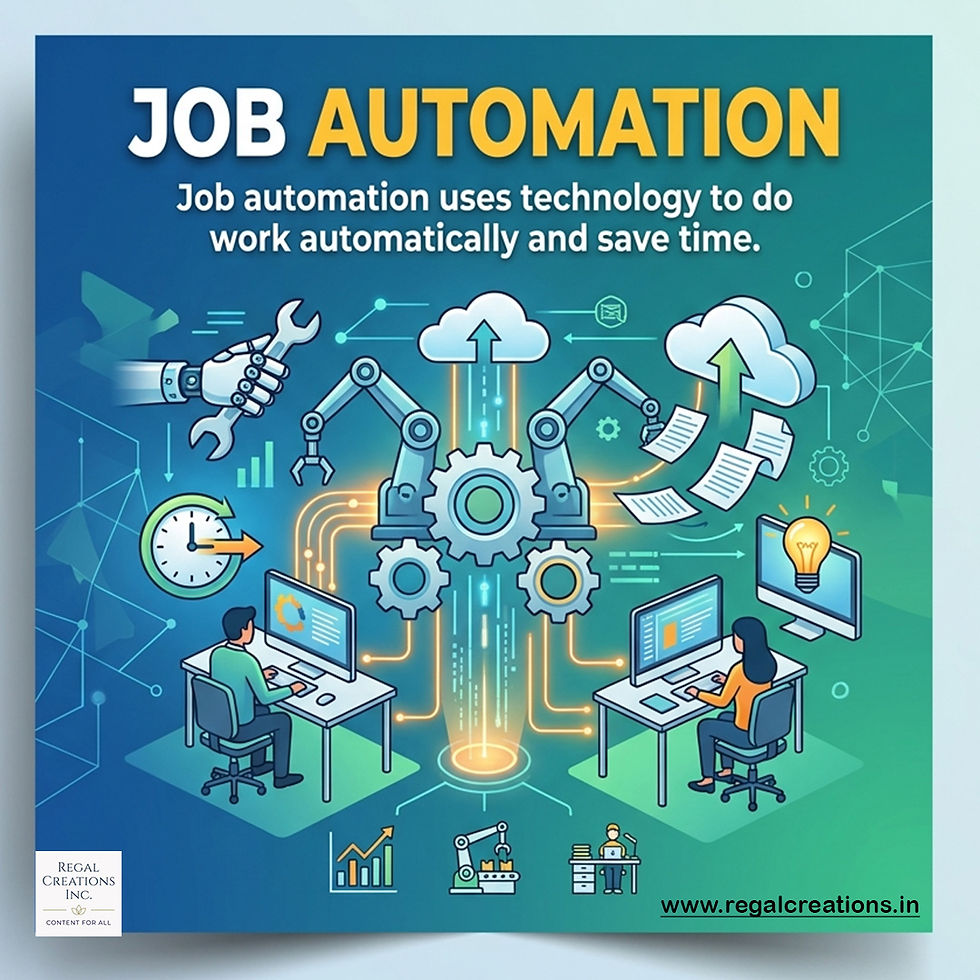
“Job automation” can mean a few different things, but at its core it’s about using technology to handle repetitive tasks so humans can focus on higher-value work. Depending on your situation, it can range from simple scripts to full-scale AI systems.
What job automation looks like
Basic automation: Using tools like spreadsheets, macros, or scripts to handle repetitive data entry
Workflow automation: Connecting apps so tasks happen automatically (e.g., when a form is submitted, a report is generated)
Robotic Process Automation (RPA): Software bots mimic human actions (clicking, copying data, etc.)
AI-driven automation: Systems that can analyze, decide, and act (e.g., chatbots, recommendation engines)
Common tools & platforms
Zapier – connects apps and automates workflows without coding
UiPath – enterprise-grade robotic process automation
Microsoft Power Automate – integrates with Microsoft ecosystem
Python – widely used for custom automation scripts
Selenium – automates web tasks
Examples of tasks you can automate
Sending emails or notifications
Data entry and report generation
Scheduling and calendar management
Customer support responses (chatbots)
File organization and backups
Benefits
Saves time and reduces errors
Scales easily as workload grows
Frees you to focus on creative or strategic work
Downsides to consider
Setup time and learning curve
Not everything can (or should) be automated
Some jobs may change or disappear
Here are practical job automation ideas for different areas that can save time and improve productivity.
Office Work Automation
Tasks you can automate
Email sorting and auto-replies
Attendance and payroll tracking
Meeting scheduling
Report generation from spreadsheets
Invoice creation and reminders
Useful tools
Microsoft Excel – formulas, macros, dashboards
Microsoft Power Automate – automate office workflows
Google Sheets – cloud-based automation with scripts
Zapier – connects apps automatically
Example
When a customer fills a form:
Data enters spreadsheet automatically
Confirmation email is sent
Manager receives notification
IT Automation
Tasks you can automate
Server monitoring
Software testing
Backups
Log analysis
Code deployment
Useful tools
Python – scripting and automation
Selenium – automated web testing
Docker – app deployment automation
Jenkins – CI/CD automation
Example
A Python script can:
Check server status every 5 minutes
Send alerts automatically if something fails
Business Automation
Tasks you can automate
Social media posting
Customer support chatbots
Inventory management
Sales tracking
Marketing emails
Useful tools
HubSpot – sales and marketing automation
Canva – quick content creation
Shopify – store automation
Mailchimp – automated campaigns
Example
An online store can automatically:
Confirm orders
Update stock
Send shipping emails
Request customer reviews
Student Task Automation
Tasks you can automate
Note organization
Study schedules
Assignment reminders
Research summaries
Flashcard creation
Useful tools
Notion – organize notes and tasks
Google Calendar – reminders and schedules
Anki – smart revision system
ChatGPT – summaries, ideas, and study help
Example
A student workflow:
Assignment deadline added to calendar
Reminder sent automatically
Notes saved in organized folders
Future of Job Automation
Automation is growing rapidly with AI. Repetitive work is increasingly handled by software, while human skills like:
creativity,
communication,
leadership,
problem-solving
are becoming more valuable.
People who learn automation tools early can improve productivity and create better career opportunities.
Job automation uses technology and AI to complete repetitive tasks faster, smarter, and with less manual effort.
The shift toward freelance work is changing how people build careers, earn money, and balance their lifestyles. Instead of working only traditional 9-to-5 jobs, many people now choose flexible, independent work opportunities through the internet and digital platforms.
What is Freelance Work?
Freelance work means offering services independently rather than being employed permanently by one company. Freelancers can work for multiple clients, often remotely.
Common freelance fields include:
Graphic design
Content writing
Video editing
Programming
Digital marketing
Online teaching
Social media management
Why Freelancing is Growing
1. Remote Work Expansion
After global shifts toward online work, companies became more comfortable hiring remote talent from anywhere in the world.
2. Flexible Lifestyle
Freelancers can:
Choose their working hours
Work from home or while traveling
Select projects they enjoy
3. Technology & Internet Access
Platforms and digital tools make it easier to find clients, communicate, and receive payments online.
Popular platforms include:
Benefits of Freelance Work
Freedom and Independence
Freelancers control:
their workload,
pricing,
schedule,
clients.
Multiple Income Sources
Instead of depending on one employer, freelancers can earn from many clients at once.
Skill Growth
Freelancing often improves:
communication,
self-management,
business skills,
creativity.
Challenges of Freelancing
Income Instability
Work may not always be consistent every month.
Self-Discipline Required
Freelancers must manage:
deadlines,
finances,
client communication,
productivity.
Competition
Global platforms create high competition, especially for beginners.
Freelancing and the Future
Many companies now prefer hiring freelancers for short-term projects because it:
reduces costs,
gives access to global talent,
increases flexibility.
At the same time, AI and automation are changing freelance work too. People with strong creative, technical, and problem-solving skills will likely have better opportunities.
Best Skills for Future Freelancers
AI tools & prompting
Graphic design
Coding & web development
Video editing
Content creation
Digital marketing
Copywriting
Data analysis
Real-World Example
A college student can:
learn graphic design online,
create social media posts for small businesses,
earn freelance income from home,
later build a personal brand or agency.
The shift toward freelance work represents a major change in modern careers. Flexibility, digital technology, and remote work opportunities are allowing more people to work independently and build income on their own terms.
Neural networks are transforming traditional industries by enabling computers to learn patterns, make predictions, and perform tasks that once required human intelligence. Inspired by the human brain, neural networks are a major part of modern artificial intelligence (AI).
What Are Neural Networks?
A neural network is a computer system made of connected “neurons” that process information and learn from data. It improves performance over time through training.
They are widely used in:
image recognition,
speech recognition,
recommendation systems,
automation,
predictive analysis.
How Neural Networks Are Changing Industries
Healthcare
Neural networks help doctors analyze medical data faster and more accurately.
Uses
Detecting diseases from X-rays and scans
Predicting patient risks
Assisting in drug discovery
AI-powered virtual assistants
Real-World Example
Google DeepMind has worked on AI systems that assist with medical image analysis.
Banking and Finance
Banks use neural networks to improve security and financial decision-making.
Uses
Fraud detection
Credit scoring
Stock market analysis
Customer support chatbots
Impact
AI systems can detect suspicious transactions much faster than traditional methods.
Manufacturing
Factories are becoming smarter with AI-powered automation.
Uses
Predictive maintenance
Quality inspection
Industrial robots
Supply chain optimization
Example
Machines can predict failures before they happen, reducing downtime and costs.
Retail and E-Commerce
Neural networks personalize shopping experiences.
Uses
Product recommendations
Demand forecasting
Customer behavior analysis
Automated customer service
Example
Amazon uses AI to recommend products based on browsing and buying behavior.
Transportation
AI is changing logistics and travel systems.
Uses
Self-driving vehicles
Traffic prediction
Route optimization
Delivery automation
Example
Tesla uses neural-network-based systems in driver assistance technologies.
Education
Neural networks are making learning more personalized.
Uses
AI tutors
Automatic grading
Language translation
Personalized study recommendations
Impact
Students can learn at their own pace with adaptive learning systems.
Challenges and Concerns
Despite the benefits, neural networks also create challenges:
Job displacement through automation
Privacy concerns
Bias in AI systems
High computing costs
Ethical questions about decision-making
Future of Neural Networks
Neural networks are expected to become even more powerful with advances in:
robotics,
generative AI,
autonomous systems,
smart cities,
scientific research.
Industries that combine human creativity with AI tools will likely grow the fastest.
Neural networks are reshaping traditional industries by improving efficiency, accuracy, automation, and decision-making. From healthcare to finance and transportation, AI-driven systems are becoming a core part of the modern economy.
Conclusion on Job Automation
Job automation is transforming the modern workplace by using technology and AI to perform repetitive and time-consuming tasks more efficiently. It helps businesses improve productivity, reduce errors, and save costs while allowing workers to focus on creative, strategic, and human-centered responsibilities. Although automation may replace some traditional jobs, it is also creating new opportunities in technology, digital services, and innovation. The future workforce will increasingly value adaptability, problem-solving, and technical skills alongside automation tools.
Thanks for reading!!!!


Comments