Corporate Language Trends

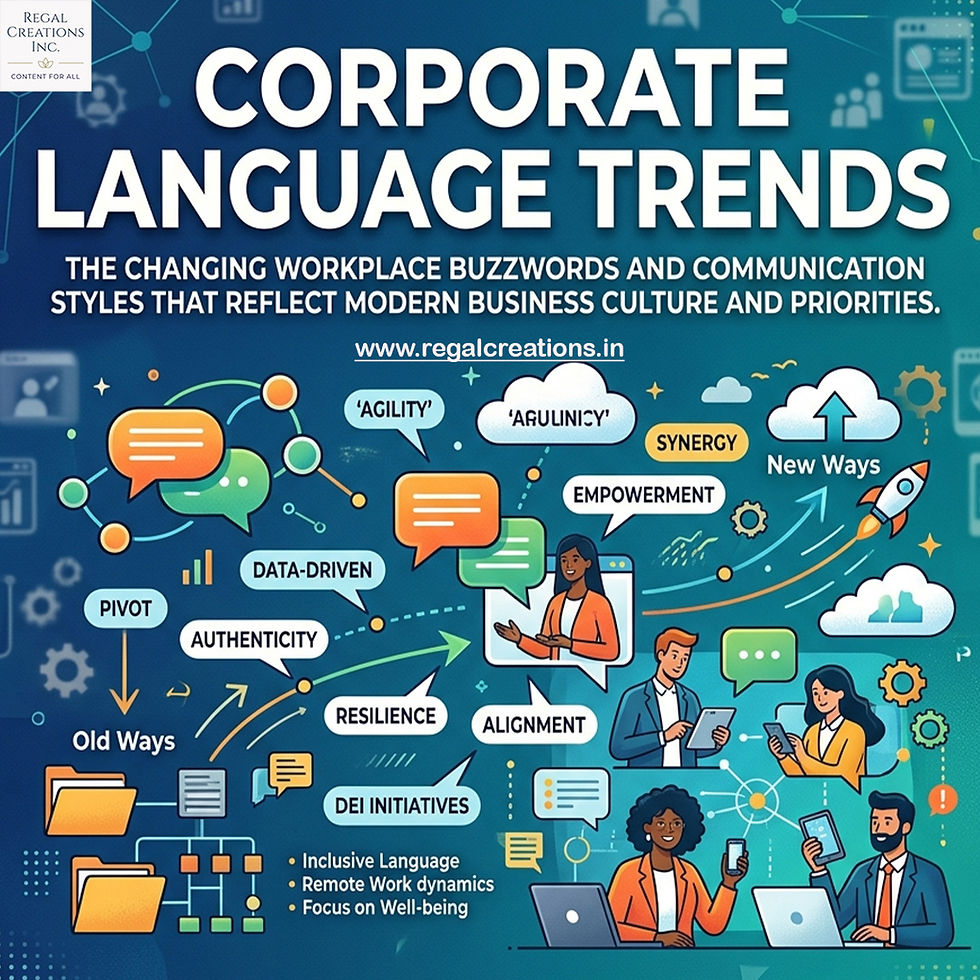
Corporate Language Trends refer to the evolving use of buzzwords, jargon, and communication styles in workplaces to reflect changing business priorities, technologies, and organizational cultures. These trends shape how companies communicate internally and externally.
Key Trends
AI and Automation Vocabulary: Terms like "AI-powered," "digital transformation," and "automation-first" are increasingly common.
Hybrid Work Language: Phrases such as "remote-first," "flexible work," and "asynchronous collaboration" reflect new workplace models.
Purpose-Driven Messaging: Companies emphasize words like "sustainability," "inclusion," "impact," and "social responsibility."
Well-being Focus: Terms such as "work-life balance," "mental wellness," and "employee engagement" have become central to corporate discourse.
Data-Driven Communication: Expressions like "actionable insights," "KPIs," and "data-informed decisions" highlight reliance on analytics.
Examples
"Let's circle back on this next week."
"We need to leverage AI to optimize workflows."
"Our strategy focuses on sustainable growth and stakeholder value."
"Let's align on deliverables before moving forward."
Impact
Positive Effects:
Creates shared understanding within organizations.
Communicates complex ideas efficiently.
Reflects modern business priorities.
Negative Effects:
Can become overly vague or confusing.
May exclude newcomers unfamiliar with jargon.
Sometimes obscures real issues behind buzzwords.
Corporate language trends mirror broader economic, technological, and cultural changes. While they can improve efficiency and cohesion, clear and straightforward communication remains essential for effective collaboration.
The rapid evolution of corporate slang has become a popular subject for both satire and analysis. As workplaces adapt to new technologies, management styles, and cultural values, they generate a constant stream of buzzwords and jargon that can sound innovative, confusing, or even absurd.
Why Corporate Slang Changes
New technologies introduce terms like "AI-driven," "automation-first," and "digital transformation."
Hybrid work creates phrases such as "async collaboration" and "remote-first culture."
Management trends popularize expressions like "move the needle," "low-hanging fruit," and "synergy."
Satirical Perspective
Corporate slang is often mocked because it can:
Replace simple language with complex jargon.
Make ordinary tasks sound more important.
Create the illusion of productivity without clear action.
Examples
"Let's circle back" = Let's discuss this later.
"Leverage our core competencies" = Use our strengths.
"Take this offline" = Discuss it privately.
"Boil the ocean" = Attempt something too large.
Analytical Perspective
Despite the jokes, corporate slang serves useful purposes:
Creates a shared workplace vocabulary.
Signals membership in a professional community.
Helps communicate complex business concepts quickly.
Reflects changing workplace priorities and values.
Corporate slang is both a practical communication tool and a source of humor. Its constant evolution reveals how organizations adapt to new challenges while also providing endless material for satire.
Email etiquette refers to the set of professional and courteous practices used when composing, sending, and responding to emails. Good email etiquette promotes clear communication, professionalism, and respect in personal and professional settings.
Key Principles of Email Etiquette
1. Use a Clear Subject Line
Summarize the purpose of the email.
Example: "Meeting Agenda for June 25" instead of "Important".
2. Start with a Professional Greeting
Use appropriate salutations such as:
Dear Mr./Ms. Sharma,
Hello Team,
Good Morning Professor,
3. Be Clear and Concise
Get to the point quickly.
Use short paragraphs and simple language.
4. Maintain a Professional Tone
Be polite and respectful.
Avoid slang, excessive emojis, or all-capital letters.
5. Check Grammar and Spelling
Proofread before sending.
Errors can affect credibility.
6. Use "Reply All" Carefully
Send responses only to relevant recipients.
Avoid unnecessary email clutter.
7. Respect Response Times
Acknowledge important emails promptly.
Follow up politely if necessary.
8. End Professionally
Use courteous closing phrases:
Regards,
Best Wishes,
Sincerely,
Thank You,
Examples
Good Email Practice
Subject: Request for Project Update
Clear greeting
Brief and organized message
Polite closing
Poor Email Practice
No subject line
Informal language like "Hey!!!"
Long, unstructured paragraphs
No signature
Email etiquette is essential for effective communication in academic, professional, and business environments. Following proper email practices helps build professionalism, clarity, and positive relationships.
While formal email guidelines are widely known, many workplace expectations are unspoken rules that help maintain professionalism and efficiency.
1. Don't Treat Email Like Instant Messaging
Avoid sending multiple one-line emails in quick succession.
Gather your thoughts into a single, organized message.
2. Respect People's Time
Keep emails concise.
If a message takes several screens to read, consider a meeting or attached document instead.
3. Reply Promptly, Even If You Don't Have an Answer
A simple "I've received this and will get back to you by Friday" is often appreciated.
4. Think Before Using "Reply All"
Many inboxes are flooded because people unnecessarily include everyone.
5. Match the Level of Formality
Observe the tone of the conversation and adapt appropriately.
A message to a CEO differs from one to a close colleague.
6. Don't Make Urgent Requests at the Last Minute
Sending an email at 5 p.m. and expecting a response by 5:30 p.m. is generally frowned upon.
7. Re-read Before Sending
Check names, attachments, dates, and recipients.
Many email mistakes happen because of rushed sending.
8. Avoid Overusing Corporate Buzzwords
Phrases like "circle back," "synergize," and "leverage" can make communication less clear.
Plain language is often more effective.
9. Be Careful with Humor and Sarcasm
Tone can be difficult to interpret in writing.
What seems funny to one person may appear rude to another.
10. Remember That Emails Can Be Forwarded
Write every email as if it could be seen by a wider audience.
Examples
Good: "Could you please send the report by Thursday?"
Less Effective: "Just following up on my previous follow-up regarding the action items discussed earlier."
The unspoken rules of email etiquette revolve around respect, clarity, and professionalism. Following them helps build trust, reduce misunderstandings, and create smoother workplace communication.
In today's hybrid corporate environment, where employees work across offices, homes, and time zones, email etiquette has evolved beyond simple professionalism. It now emphasizes clarity, flexibility, digital awareness, and respect for asynchronous communication.
Key Features of Modern Email Etiquette
1. Respect Asynchronous Work
Not everyone is online at the same time. Avoid expecting immediate responses unless the matter is truly urgent.
2. Write for Quick Scanning
Busy professionals often read emails on phones between meetings. Use:
Clear subject lines
Bullet points
Short paragraphs
Action items at the top
3. Be Intentional About Urgency
Mark emails as urgent only when necessary. Overusing urgency reduces its effectiveness.
4. Choose the Right Channel
Not every message belongs in email.
Quick questions → Chat platforms
Complex discussions → Meetings
Formal records and decisions → Email
5. Be Mindful of Time Zones
Hybrid teams often span multiple regions. Avoid assuming recipients are available during your working hours.
6. Balance Professionalism and Warmth
Modern workplace communication tends to be less rigid than traditional corporate correspondence while remaining respectful and professional.
7. Avoid Digital Overload
Reduce unnecessary CCs, reply-all chains, and lengthy email threads that contribute to inbox fatigue.
Examples
Traditional Corporate Email
"Please revert at your earliest convenience regarding the aforementioned matter."
Modern Hybrid Email
"Could you share your feedback by Wednesday? Let me know if you need more time."
Email etiquette in the modern hybrid corporate world is about communicating clearly, respecting flexible work patterns, and reducing digital friction. Success depends not only on what you say but also on how thoughtfully you manage others' attention and time.
Unspoken Rules of the Modern Hybrid Corporate World
The modern hybrid workplace runs on more than official policies. Success often depends on understanding the unwritten expectations that shape communication, visibility, and collaboration.
1. Visibility Still Matters
Even when performance is measured by results, people who regularly communicate their progress tend to be noticed more than those who work quietly in the background.
2. "Available" Doesn't Mean Available
A green status indicator is not an invitation for instant responses. Respect colleagues' focus time and schedules.
3. Meetings Are Often About Presence, Not Just Information
Sometimes attendance signals engagement and commitment, even when the information could have been shared in a document.
4. Prompt Responses Build Trust
You don't need an immediate answer, but acknowledging messages quickly reassures others that work is moving forward.
5. Documentation Is a Superpower
In distributed teams, decisions that aren't documented can effectively disappear. Written records often matter as much as verbal discussions.
6. Learn the Digital Hierarchy
Different channels carry different meanings:
Chat = quick discussions
Email = formal communication
Video call = complex conversations
Shared documents = long-term record
7. Camera Etiquette Is Contextual
Many organizations claim cameras are optional, but reading the room and team culture often matters more than the written policy.
8. Overcommunication Is Safer Than Undercommunication
Remote work reduces informal updates, so people are expected to proactively share progress, blockers, and timelines.
9. Work-Life Boundaries Are Negotiated, Not Guaranteed
Hybrid work offers flexibility, but employees are often expected to manage availability and boundaries themselves.
10. Corporate Buzzwords Signal Belonging
Terms like alignment, bandwidth, stakeholders, ownership, and synergy often function as social signals that demonstrate familiarity with workplace culture.
11. Informal Networks Still Drive Opportunities
Career advancement often depends not only on performance but also on maintaining relationships across teams and departments.
12. Flexibility Comes with Accountability
Hybrid work grants autonomy, but organizations usually expect stronger self-management, reliability, and measurable outcomes in return.
Examples
A remote employee sends weekly progress updates to stay visible.
A manager documents meeting decisions in a shared workspace.
Team members check colleagues' time zones before scheduling calls.
The unspoken rules of the modern hybrid corporate world revolve around visibility, communication, adaptability, and relationship-building. While technology has changed where work happens, human expectations about trust, collaboration, and reputation remain surprisingly consistent.
Examples of Corporate Language Trends
Corporate language trends reflect changing workplace cultures, management philosophies, and technologies. Here are some common examples found in today's hybrid and digital-first workplaces:
Corporate Phrase | What It Usually Means |
Let's circle back. | Let's discuss this later. |
Take this offline. | Discuss it privately or outside the current meeting. |
Move the needle. | Make a meaningful impact. |
Low-hanging fruit. | Easy opportunities or quick wins. |
Bandwidth. | Available time, energy, or capacity. |
Deep dive. | Detailed analysis of a topic. |
Synergy. | Effective collaboration between teams. |
Align on this. | Reach agreement or shared understanding. |
Leverage our strengths. | Use existing advantages or resources. |
Actionable insights. | Information that can guide decisions. |
Touch base. | Briefly connect or check in. |
Stakeholders. | People affected by or interested in a project. |
Deliverables. | Expected outputs or completed tasks. |
Pivot. | Change direction or strategy. |
Own the project. | Take responsibility for it. |
Modern Hybrid-Work Buzzwords
Async communication – Communication that doesn't require immediate responses.
Remote-first – Designed primarily for distributed teams.
Digital transformation – Using technology to improve operations.
AI-powered – Enhanced through artificial intelligence.
Flexible work – Work arrangements with location or schedule flexibility.
Employee experience – Overall experience of workers within an organization.
Satirical Examples
Corporate language is often mocked because simple ideas become overly complex:
"Let's leverage cross-functional synergies to optimize stakeholder value."
Translation: Let's work together and do a better job.
"I'm at capacity right now."
Translation: I'm too busy.
"Can we socialize this idea?"
Translation: Can we share this with others?
Corporate language trends evolve with business culture, technology, and workplace practices. While jargon can improve efficiency among insiders, excessive use often leads to confusion and becomes a target of workplace humor.
Conclusion on Corporate Language Trends
Corporate language trends evolve alongside changes in technology, workplace culture, and business priorities. While buzzwords and jargon can streamline communication and create a shared professional vocabulary, excessive use may lead to confusion and ambiguity. The most effective corporate communication balances modern terminology with clarity, ensuring that messages remain meaningful, accessible, and action-oriented.
Thanks for reading!!!!!


Comments