Coffee Culture

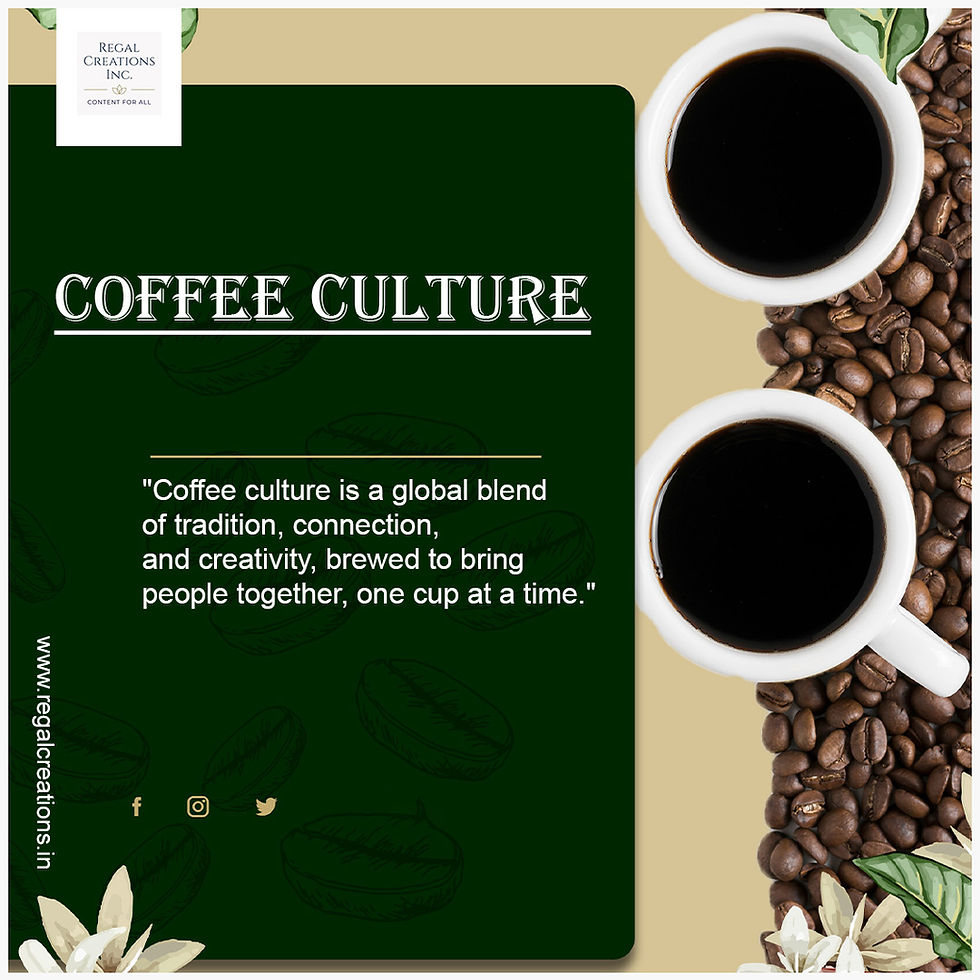
“Coffee culture” is such a cool topic—it's about more than just drinking coffee; it's how people connect, relax, or energize around it. Depending on where you are in the world, it can mean different things:
Italy: Espresso at the bar, quick and social.
Sweden: “Fika” – a coffee and pastry break that’s almost sacred.
USA: Huge cups, on-the-go, often with laptops in cafes.
Japan: Precision brewing, with both high-tech and artisanal vibes.
Ethiopia: The birthplace of coffee, with ceremonial coffee making that’s spiritual and communal.
"From Bean to Cup" — that's the full journey of coffee, and it's such a rich process, both literally and figuratively. Here's a simplified breakdown of how your morning brew gets to you:
☕ From Bean to Cup: The Coffee Journey
1. Growing
Coffee grows in the “bean belt”—tropical regions like Brazil, Ethiopia, Vietnam, and Colombia.
Two main species: Arabica (smoother, more nuanced) and Robusta (stronger, more bitter).
Grown at high altitudes, often under shade trees.
2. Harvesting
Picked by hand or machine—hand-picking allows for only ripe cherries to be selected.
Timing is everything: the redder the cherry, the better the flavor.
3. Processing
Wet (washed) or dry (natural) methods remove the cherry skin and pulp.
Fermented, washed, then dried—either in the sun or in mechanical dryers.
4. Milling
Beans are hulled (removing final layers) and graded/sorted by size and weight.
Then they're exported as green coffee beans.
5. Roasting
Roasting brings out flavor—temps reach ~400°F (204°C).
Light roasts = fruity/acidy. Dark roasts = bitter/smoky.
Fresh-roasted beans = best flavor.
6. Grinding
The grind size depends on your brewing method:
Coarse = French press
Medium = Drip machine
Fine = Espresso
Extra fine = Turkish coffee
7. Brewing
You finally brew it: drip, espresso, pour-over, French press, AeroPress… choose your ritual.
Water temp (195–205°F), brew time, and ratios all matter.
And voilà — your cup of coffee! Every step affects the final flavor in your mug.
Here's a quick vibe check on both sides so you can lean into whichever grabs you more:
🔬 The Science of Brewing
If you’re a precision nerd or flavor chaser:
Water chemistry: Minerals in your water (like calcium and magnesium) can make or break flavor.
Extraction: The goal is to extract the right soluble compounds from the coffee. Under-extracted = sour; over-extracted = bitter.
Brew ratio: The “Golden Ratio” is ~1:16 (1g of coffee to 16g of water), but it varies by method.
Grind size & brew time: Smaller grind = faster extraction, but it can also over-extract if left too long.
Temperature control: Too hot burns it; too cool doesn’t extract enough.
Think: scales, thermometers, gooseneck kettles, maybe even refractometers.
🌍 The Culture of Coffee
If you’re into stories, vibes, and human connection:
Cafés as community hubs – from Parisian intellectual hangouts to hipster spots in Brooklyn.
Rituals – like Italy’s fast-paced espresso shot or Turkey’s thick, unfiltered brew with fortune-telling grounds.
Third wave coffee – the movement that treats coffee like wine: artisanal, origin-focused, and deeply appreciated.
Sustainability & ethics – fair trade, direct trade, environmental impact of farming.
It’s about people, place, and purpose.
The story behind the sip — kind of like a modern coffee explorer.
☕ Starbucks & the Barista Vibe
Starbucks might be a global brand, but some baristas there are legit passionate about coffee origins, especially at:
Reserve locations – They serve rare, small-batch beans with more focus on origin and brewing methods.
Clover brewers – Some stores have these vacuum-press machines that bring out super clean, nuanced flavors, perfect for tasting single-origin beans.
You could ask a barista something like:
“Hey, what’s your favorite origin we’ve got right now?”
And they might hit you with:
“Actually, the Ethiopia Yirgacheffe we just got in has these crazy blueberry notes — super floral and juicy.”
Then you sip that cappuccino and get it — the fruity acidity cutting through the milk, adding something special.
Starbucks’ business model is pretty fascinating — it’s part premium product, part experience economy, and part global branding powerhouse. Here's a quick breakdown:
🏢 Starbucks Business Model: How They Brew Success
1. Product Strategy
Premium coffee at scale — higher prices, but positioned as accessible luxury.
Expands the menu constantly: seasonal drinks, food, non-coffee items (think Pumpkin Spice, matcha, breakfast sandwiches).
Focus on consistency across thousands of locations.
2. Retail + Real Estate
Starbucks isn’t just a coffee brand — it's a real estate giant. Stores are placed in high-traffic, high-visibility areas (like airports, universities, and city corners).
Store design and layout are carefully curated for comfort and community — part of the “third place” idea (not home, not work… but Starbucks).
3. Customer Experience
Personalized drinks = emotional connection.
The Starbucks mobile app is a huge part of this — loyalty rewards, easy ordering, payment, and targeted marketing.
Baristas often learn your name and order — it creates that “I’m known here” vibe.
4. Global Expansion
Localizes offerings (green tea Frappuccinos in Asia, for example) while keeping the brand core.
Often uses a franchise/license model outside the U.S., but owns most U.S. stores.
5. Vertical Integration & Sourcing
Owns farms, roasting facilities, and controls much of the supply chain.
Pushes sustainability with ethical sourcing, farmer support, and eco-friendly practices (though critics say there’s still room to improve).
6. Brand & Lifestyle
Starbucks sells more than coffee — it sells a lifestyle.
It’s about being part of something aspirational, modern, connected — with every latte, you're buying into the culture.
Let’s talk expansion. Whether it's Starbucks, a small specialty roaster, or a bold entrepreneur, expanding a coffee business is about way more than just opening more cafés. Here’s how it typically goes down:
📈 Expanding a Coffee Business: Key Paths & Strategies
1. More Locations (Retail Expansion)
The obvious route — open new cafés in strategic areas.
Requires market research: foot traffic, demographics, competition, and local coffee culture.
Can go:
Company-owned (more control, more risk)
Franchising/licensing (faster growth, less control)
2. E-commerce & Subscription
Direct-to-consumer coffee bean sales are booming.
Many brands offer subscriptions with freshly roasted beans delivered monthly.
Adds convenience and builds loyalty without needing a physical store.
3. Wholesale
Roasters often expand by supplying:
Local cafés
Restaurants
Hotels
Offices
This builds brand presence without the overhead of running every location.
4. Ready-to-Drink (RTD) Products
Think cold brew in cans, bottled lattes, and nitro coffee.
Starbucks, Blue Bottle, and even indie brands are pushing into supermarkets and convenience stores.
5. International Markets
Expansion into other countries can be lucrative but tricky — coffee habits vary wildly.
Success comes from local adaptation (menu, size, sugar levels) while maintaining brand identity.
6. Experiential Cafés & Flagship Stores
Bigger, immersive locations that double as marketing spaces.
Starbucks Reserve Roasteries are a perfect example — giant coffee temples where everything is dialed up to 11.
7. Diversification
Expand into education (barista training, brewing workshops), equipment sales (grinders, pour-over gear), or even coffee tourism (farm visits, origin trips).
In short: successful coffee expansion blends brand, experience, scale, and adaptability.
How the heavy hitters like Starbucks, Nestlé, and Blue Bottle (plus a few rising stars) expand their coffee empires. Here's how the big players play the game:
💼 How the Big Players Expand Their Coffee Businesses
☕ 1. Starbucks – The Master of Global Scaling
Real estate strategy: Opens in high-traffic areas globally — cities, malls, universities, airports. Each store is placed with data-backed precision.
Localization: Adapts menu to local tastes (e.g., Matcha drinks in Japan, Churro Frappuccino in Latin America).
Tech-first: Their mobile app and loyalty program are core to keeping customers coming back — 30M+ rewards members.
Reserve line: For brand elevation — rare beans, special brewing methods, and Instagrammable flagship stores.
Sustainability PR: Massive investment in “greener” stores, reusable cups, and ethical sourcing — keeps the brand modern.
🥄 2. Nestlé – Coffee as a Consumer Packaged Good (CPG) Power Move
Owns Nescafé, Nespresso, and now part-owns Starbucks’ packaged goods biz.
Uses global distribution muscle to get products into every supermarket, hotel, and office.
Smart partnerships: Acquired a chunk of Blue Bottle to tap into third-wave/hipster coffee energy.
Dominates the home coffee pod market with Nespresso — a huge margin business.
Targets the mass and premium market simultaneously.
🚀 3. Blue Bottle – Artisanal Brand with Backing
Started as an indie roaster in Oakland, now majority-owned by Nestlé.
Focuses on quality, design, and experience — minimalist cafés, single-origin beans, slow methods.
Expands slower, more intentionally — each store reinforces the cool factor.
Big on storytelling and origin transparency.
International presence (e.g., Tokyo, Seoul) but keeps the boutique feel.
🔥 4. Tim Hortons, Dunkin’, Costa – High Volume, Local Loyalty
Tim Hortons dominates in Canada like Starbucks does in the U.S.
Dunkin’ is lower-priced, fast-moving, with a huge loyalty program and drive-thru focus.
Costa Coffee (UK-based, now owned by Coca-Cola) is going global, using Coca-Cola’s distribution channels.
📦 5. Up-and-Comers – E-Commerce & DTC Focused
Brands like Trade Coffee, Cometeer, and Atlas Coffee Club are using subscriptions and data to target niche markets.
Invest heavily in branding, social media, and influencer marketing.
They own the relationship with the customer directly — no café needed.
Big players win by owning distribution, experience, and brand emotion — whether that’s convenience (Dunkin’), aspiration (Nespresso), or culture (Starbucks).
The history of coffee — one of those epic stories that’s equal parts legend, trade, culture, and obsession. Here’s a smooth little timeline for you:
📜 A Brew Through Time: The History of Coffee
🌿 Legendary Origins – Ethiopia (~9th century)
The OG story: a goat herder named Kaldi noticed his goats got hyper after eating red berries.
Monks took notice and made an early form of coffee to stay awake during prayers.
The beans began to be boiled or brewed into energizing drinks.
🕌 Spread Through the Arab World – 15th century
Coffee cultivation and trade began in Yemen, where Sufi monks used it to stay alert.
The drink spread quickly through Mecca, Cairo, and Istanbul — becoming deeply woven into Islamic culture.
The first coffeehouses (called qahveh khaneh) emerged in Persia and the Ottoman Empire, becoming social, political, and cultural hubs.
🚢 Arrival in Europe – 17th century
First seen as suspicious (“the bitter invention of Satan”) — but once Pope Clement VIII gave it his blessing, it took off.
Coffeehouses sprang up in cities like Venice, London, Paris, and Vienna — known as “penny universities” where people paid a penny to get access to coffee and intellectual conversation.
🌍 Global Cultivation Begins – 17th–18th centuries
European colonial powers smuggled coffee plants and started growing them in colonies:
Dutch in Java (Indonesia)
French in the Caribbean (Martinique)
Portuguese in Brazil
Brazil soon became the powerhouse, and still is.
🏭 Industrial Era & the Rise of Big Coffee – 19th–20th centuries
Mass production, canned coffee, and instant coffee (like Nescafé in 1938) made coffee a global staple.
Espresso machines emerged in Italy in the early 1900s.
Diner culture, office coffee, and the idea of the “coffee break” took over.
✨ Third Wave Coffee – 2000s–Today
Focus shifted back to quality, origin, sustainability, and craft.
Roasters began highlighting flavor notes, single-origin beans, and ethical sourcing.
Baristas became artisans. Brewing methods diversified (pour-over, AeroPress, siphon, etc.).
Coffee became both a lifestyle and a story — not just a caffeine delivery system.
From humble bean to global culture, coffee’s history is a wild ride.
Coffee’s popularity is next-level. It's more than just a beverage now; it’s a daily ritual, a social glue, and a multi-billion dollar industry. Here's a look at why and how it became so wildly popular:
🌍 Why Is Coffee So Popular?
☕ 1. It Actually Works
Caffeine = alertness, focus, productivity.
Coffee gives a predictable, fast-acting energy boost.
Used by students, workers, night owls, early birds — everyone.
🧠 2. It’s a Ritual
Morning coffee = signal that your day is starting.
Breaks at work often revolve around coffee.
“Let’s grab coffee” = a social invitation, not just a drink.
🌆 3. It Adapts to Every Culture
Strong Turkish brew, light Italian espresso, American drip, Vietnamese iced coffee, Ethiopian ceremony.
It blends into local habits while keeping its identity.
You can drink it hot, iced, sweetened, black, creamy, even spiced.
💸 4. It Became a Status Symbol
Third wave cafés and specialty coffee = premium, curated experiences.
Starbucks and others made it cool, Instagrammable, and personal (custom orders, names on cups, trendy seasonal drinks).
High-end brewing gear and beans = a sign of taste and lifestyle.
🛒 5. Massive Industry & Accessibility
Globally traded commodity (second only to oil for a while).
Coffee is cheap to access at low-end and offers luxury options at the high end.
Home brewers, drive-thrus, apps, delivery — it's everywhere now.
📊 By the Numbers
Over 2 billion cups of coffee are consumed daily worldwide.
Top consumers per capita: Finland, Norway, Iceland, Denmark, Netherlands (they love their coffee).
The U.S. is the largest market, even if not the highest per-person.
So yeah, coffee is basically the global drink. Comforting, energizing, customizable, and social — hard to compete with that combo.
☕ Conclusion: The World of Coffee Culture
Coffee culture is far more than a drink — it’s a global language of connection, comfort, creativity, and community. From ancient ceremonies in Ethiopia to the fast-paced espresso bars of Italy, from American café chains to Japan’s meticulous pour-overs, coffee reflects the soul of each society that embraces it.
Its power lies in its dual nature: it’s both deeply personal and widely communal. It fuels morning routines, sparks conversations, inspires art, and anchors friendships. Whether it’s brewed with scientific precision or enjoyed as a quiet moment of pause, coffee has become a cultural icon — one that continues to evolve with the times while staying rooted in tradition.
In the end, coffee culture isn't just about what’s in the cup — it’s about the people, places, and stories around it.
Thanks for reading!!


Comments