AgTech and Food Scarcity

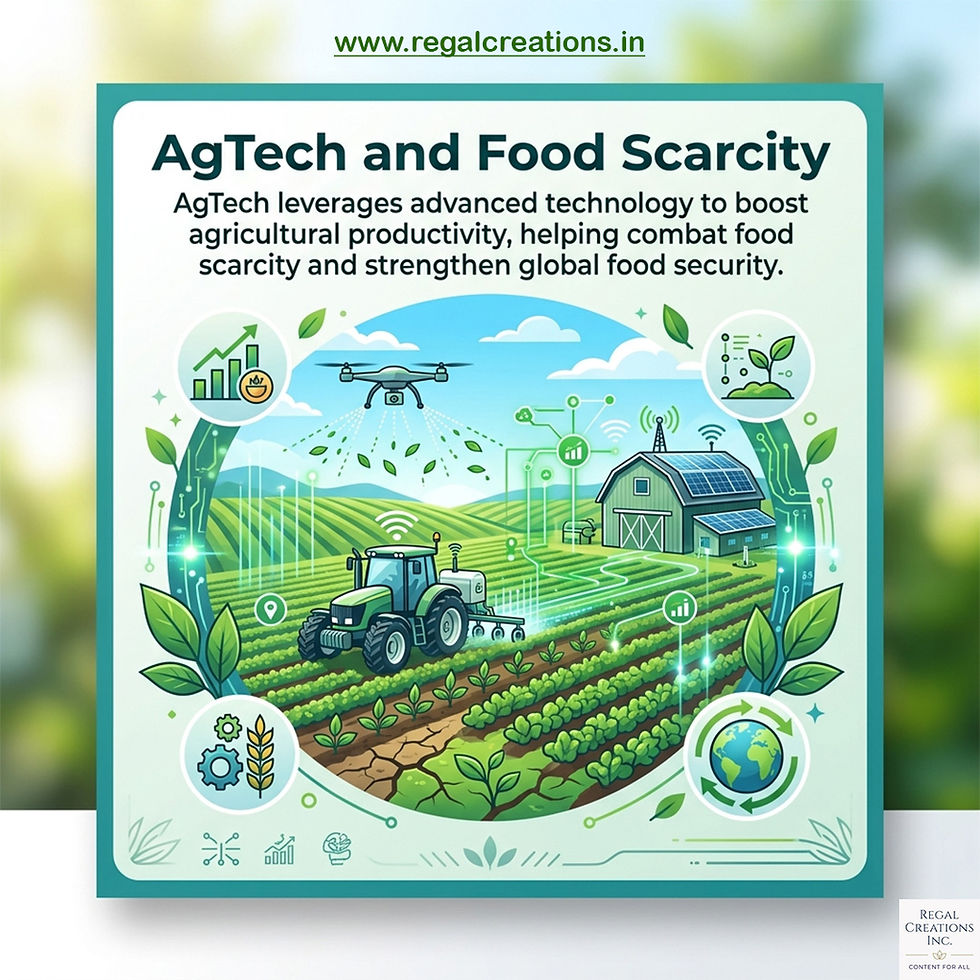
AgTech and Food Scarcity
AgTech (Agricultural Technology) refers to the use of modern technologies such as artificial intelligence (AI), drones, sensors, biotechnology, robotics, and data analytics to improve agricultural productivity and sustainability. As global populations grow and climate change threatens food production, AgTech is increasingly seen as a solution to food scarcity.
How AgTech Helps Address Food Scarcity
1. Precision Agriculture
Farmers use GPS, sensors, and AI to monitor soil conditions, water levels, and crop health. This reduces waste and increases yields.
2. Smart Irrigation
Automated irrigation systems deliver water only when and where needed, conserving water and improving crop growth.
3. Genetically Improved Crops
Biotechnology helps develop crops that are resistant to drought, pests, and diseases, ensuring more reliable harvests.
4. Drones and Remote Sensing
Drones can monitor large fields, detect problems early, and assist in targeted pesticide and fertilizer application.
5. Vertical Farming
Crops are grown indoors in stacked layers using controlled environments, allowing food production in urban areas with limited land.
6. Robotics and Automation
Machines can perform planting, harvesting, and weeding more efficiently, reducing labor shortages and increasing productivity.
Examples of AgTech
John Deere uses AI-enabled tractors and smart farming systems.
CropX provides soil sensors for precision farming.
Plenty grows crops in controlled indoor environments.
AeroFarms produces vegetables using aeroponic technology.
Challenges
High initial costs for technology adoption.
Limited access for small-scale farmers in developing countries.
Dependence on internet connectivity and technical expertise.
Concerns about data privacy and ownership.
AgTech offers innovative solutions to increase food production, improve resource efficiency, and strengthen food security. While it cannot solve food scarcity alone, it plays a crucial role in creating a more sustainable and resilient global food system.
Lab-grown meat (also called cultivated meat or cell-based meat) is real animal meat produced by growing animal cells in a controlled environment rather than raising and slaughtering animals.
The Process
1. Cell Collection
Scientists take a small sample of muscle cells from a living animal, such as a cow, chicken, or fish.
2. Cell Cultivation
The cells are placed in nutrient-rich growth media containing proteins, vitamins, minerals, and amino acids that help them multiply.
3. Growth in Bioreactors
The cells grow inside large tanks called bioreactors, where temperature, oxygen, and nutrients are carefully controlled.
4. Tissue Formation
The cells are encouraged to develop into muscle, fat, and connective tissues, creating the structure and flavor of meat.
5. Harvesting
Once enough tissue has formed, the cultivated meat is harvested, processed, and prepared for consumption.
Benefits
Reduces the need for animal slaughter.
Requires less land and potentially less water.
May lower greenhouse gas emissions compared to conventional livestock farming.
Can improve food security by producing meat in controlled environments.
Reduces the risk of some animal-borne diseases.
Challenges
High production costs.
Scaling up production for mass markets.
Consumer acceptance and regulatory approval.
Energy requirements for large-scale facilities.
Examples
UPSIDE Foods develops lab-grown chicken products.
GOOD Meat produces cultivated chicken.
Mosa Meat focuses on lab-grown beef.
Lab-grown meat offers a promising way to meet growing global demand for protein while reducing environmental pressures and animal welfare concerns. However, cost and large-scale production remain major challenges.
Vertical farming is the practice of growing crops in vertically stacked layers, often inside buildings, warehouses, or specially designed structures. It uses controlled environments and advanced technologies to produce food year-round with minimal land use.
How Vertical Farming Works
1. Stacked Growing Systems
Plants are grown in multiple layers, maximizing production within a small footprint.
2. Controlled Environment Agriculture (CEA)
Temperature, humidity, light, and nutrients are carefully managed to optimize plant growth.
3. Hydroponics
Plants grow in nutrient-rich water instead of soil.
4. Aeroponics
Plant roots are suspended in air and sprayed with nutrient solutions.
5. Artificial Lighting
Energy-efficient LED lights provide the specific wavelengths needed for photosynthesis.
Advantages
Uses up to 90–95% less water than traditional farming.
Requires significantly less land.
Produces crops throughout the year regardless of weather.
Reduces transportation costs by growing food near cities.
Minimizes pesticide use due to controlled conditions.
Challenges
High setup and operating costs.
Significant electricity consumption for lighting and climate control.
Best suited for leafy greens, herbs, and some vegetables; staple crops remain difficult to grow economically.
Requires technical expertise and continuous monitoring.
Examples of Vertical Farming Companies
AeroFarms
Plenty
Bowery Farming
Infarm
Role in Food Scarcity
Vertical farming can help address food scarcity by producing fresh food in urban areas, reducing dependence on climate conditions, and increasing local food availability. While it cannot replace traditional agriculture, it can supplement food production, especially in regions with limited arable land.
Vertical farming is an innovative agricultural method that grows crops in stacked indoor systems using controlled environments. It offers efficient land and water use, making it a promising tool for sustainable food production in the future.
Genetically resilient crops are crop varieties that have been developed through genetic engineering, gene editing, or advanced breeding techniques to withstand environmental stresses such as drought, floods, pests, diseases, and extreme temperatures.
Why They Are Important
Climate change, population growth, and declining natural resources are putting pressure on global food systems. Genetically resilient crops help maintain food production even under difficult growing conditions.
Key Types of Resilience
1. Drought Resistance
These crops require less water and can survive prolonged dry periods.
2. Pest Resistance
Built-in resistance reduces damage from insects and lowers pesticide use.
3. Disease Resistance
Crops are developed to withstand fungal, bacterial, and viral infections.
4. Heat Tolerance
Plants continue growing and producing yields despite high temperatures.
5. Flood and Salinity Tolerance
Some varieties can survive waterlogged soils or high salt concentrations.
Examples
Bt Cotton — Resistant to certain insect pests.
Golden Rice — Developed to address nutritional deficiencies.
Drought-tolerant maize varieties used in parts of Africa.
Salt-tolerant rice varieties cultivated in coastal regions.
Benefits
Higher and more stable crop yields.
Improved food security.
Reduced pesticide and water use.
Better adaptation to climate change.
Increased farmer productivity and income.
Challenges and Concerns
High research and development costs.
Regulatory and ethical debates surrounding genetic modification.
Potential dependence on patented seeds.
Concerns about biodiversity and long-term ecological impacts.
Role in Combating Food Scarcity
Genetically resilient crops can help ensure reliable harvests in areas affected by climate change and resource scarcity. By reducing crop losses and improving productivity, they contribute to a more secure global food supply.
Genetically resilient crops are a powerful agricultural innovation designed to withstand environmental challenges while maintaining productivity. They offer significant potential for strengthening food security in a changing climate.
“Reshaping Our Dinners” refers to the transformation of what and how we eat due to technological innovation, environmental concerns, health awareness, and changing consumer preferences. As the global population grows and climate challenges intensify, the future of food is evolving rapidly.
Key Trends Reshaping Our Dinners
1. Plant-Based Foods
More people are choosing plant-based alternatives to reduce environmental impact and improve health.
2. Lab-Grown Meat
Cultivated meat offers real animal protein without traditional livestock farming, potentially reducing land use and greenhouse gas emissions.
3. Vertical Farming
Urban indoor farms provide fresh vegetables year-round while using less water and land.
4. Genetically Resilient Crops
Climate-resistant crops help ensure stable food supplies despite droughts, floods, and extreme weather.
5. Smart Agriculture
AI, drones, sensors, and data analytics improve food production efficiency and reduce waste.
6. Sustainable Diets
Consumers are increasingly choosing locally sourced, seasonal, and environmentally friendly foods.
Examples
4
Plant-based burgers and dairy alternatives.
Cultivated chicken and beef products.
Leafy greens produced in vertical farms.
Climate-resilient rice, wheat, and maize varieties.
Benefits
Greater food security.
Reduced environmental impact.
Improved resource efficiency.
Healthier dietary options.
More resilient food systems.
Challenges
High costs of emerging food technologies.
Consumer acceptance of novel foods.
Regulatory and ethical concerns.
Ensuring equitable access to innovation.
Reshaping our dinners is about creating a food system that is sustainable, nutritious, and capable of feeding a growing global population. Innovations such as lab-grown meat, vertical farming, and resilient crops are changing not only what we eat but also how food is produced and distributed.
Conclusion on AgTech and Food Scarcity
AgTech is playing a crucial role in addressing global food scarcity by making agriculture more productive, efficient, and sustainable. Through innovations such as precision farming, vertical farming, smart irrigation, AI-driven analytics, and genetically resilient crops, farmers can produce more food while using fewer resources. Although challenges such as high costs, technological accessibility, and infrastructure limitations remain, AgTech offers promising solutions for feeding a growing population and building a more resilient food system in the face of climate change.
Thanks for reading !!!!!!!


Comments